
Packaged sewage treatment plant: the complete buyer's guide
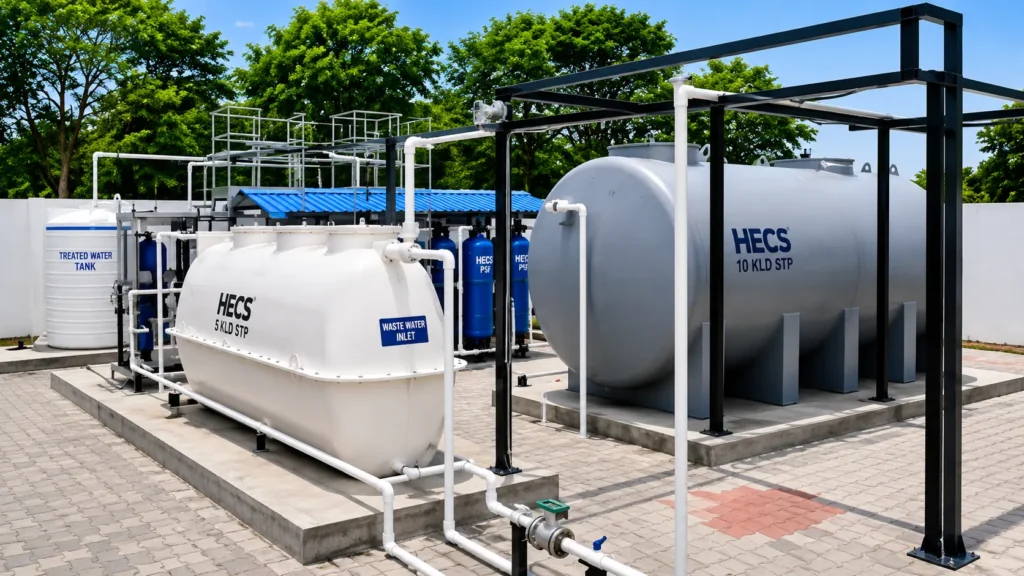
A packaged sewage treatment plant (packaged STP or PSTP) is a compact, factory-built system that treats sewage on site so the water can be safely discharged or reused. It arrives pre-assembled and tested, needs little civil work, and installs in days instead of the months a conventional concrete STP takes.
- 28+ years of Hubert Enviro Care Systems, since 1997
- 1–1,000 KLD per unit, from a villa to a township
- 95–99% BOD removal (design performance)
- ~2 days to install an Ultima unit
Share your flow, site and reuse needs. Our engineers reply with a sized proposal.
HECS packaged STP at a glance
In short: one factory-built FRP unit treats 1 to 1,000 KLD with MBBR, SBR or MBR, installs above or below ground, and is monitored over IoT.
| Feature | HECS packaged sewage treatment plant |
|---|---|
| Technology | MBBR, SBR or MBR, selected for your sewage, space and reuse needs |
| Construction | Factory-fabricated FRP (fibre-reinforced plastic) tanks: corrosion-resistant and leak-proof |
| Capacity | 1 KLD to 1,000 KLD per unit, from a villa to an industrial township; larger flows use multiple modules |
| Performance | 95–99% BOD removal (HECS design performance) |
| Installation | Above or below ground, with minimal civil work |
| Monitoring | IoT remote monitoring with alerts and performance reports |
| Treated water | Designed to meet CPCB and State Pollution Control Board norms; reusable for flushing, gardening and cooling |
| Support | Design, supply, installation, commissioning, O&M, AMC and lab testing |
How does a packaged sewage treatment plant work?
In short: sewage is screened, treated by bacteria with air, settled, filtered and disinfected inside one compact unit.
- Screening, sedimentation and equalisationRemoves solids and evens out the morning and evening peaks in flow.
- Anoxic/anaerobic treatmentStarts breaking down organic matter without air.
- Aerobic MBBR treatmentA blower supplies air to bacteria on floating MBBR media, which consume the remaining BOD and COD.
- Sedimentation and recirculationThe biomass settles and sludge returns to the first chamber.
- Filter feed tankHolds the clarified water for polishing.
- Sand, carbon and bag filtersRemove fine solids, colour and odour (tertiary treatment, included in Ultima+).
- DisinfectionKills pathogens before the water is reused or discharged.

SBR and MBR packaged plants follow the same path, but SBR settles the water in timed cycles in one tank, and MBR uses membranes instead of a settler and filters.
Types of packaged sewage treatment plants: MBBR, SBR and MBR
In short: MBBR for reliable, low-maintenance treatment, SBR for cost-effective treatment, MBR for maximum water reuse.
| Technology | How it works | Best for | HECS model |
|---|---|---|---|
| MBBR (Moving Bed Biofilm Reactor) | Bacteria grow on floating plastic media in an aerated tank | Reliable, low-maintenance treatment, even when loads change | HECS Ultima Series |
| SBR (Sequencing Batch Reactor) | Aeration and settling happen in one tank, in timed cycles | Cost-effective treatment | Designed to order |
| MBR (Membrane Bioreactor) | Membranes replace the settler and filters | Maximum water reuse, smallest footprint | HECS Amaze MBR |
HECS recommends the technology after checking your sewage quality, available space, discharge norms and future expansion. New-generation packaged STPs such as HECS Ultima add IoT sensors and automation, so operators can track performance and get alerts remotely.
Why FRP? FRP tanks do not rust like mild steel, weigh far less than concrete and are leak-tested before dispatch. Read our FRP packaged STP buying guide.
Packaged STP vs conventional STP
In short: a packaged plant is factory-built and installs in days; a conventional plant is built in concrete on site over months.
| Packaged STP | Conventional (civil) STP | |
|---|---|---|
| Built | In a factory, pre-tested | On site, in concrete |
| Installation time | Days to a few weeks | Several months |
| Space | Compact; above or below ground | Needs more land |
| Expansion or relocation | Add modules; the plant can be moved | Fixed |
| Quality control | Factory-controlled | Depends on site work |
| Best for | Apartments, villas, hotels, hospitals, schools, offices, factories, camps and remote sites | Large municipal flows |
What size packaged STP do you need?
Size the plant on your daily sewage flow in KLD (kilolitres per day; 1 KLD = 1,000 litres a day). A common design basis from CPHEEO norms:
Example: a 100-flat block with 5 residents per flat, each using 135 litres a day, produces 100 × 5 × 135 × 0.8 = 54,000 litres a day (54 KLD). A 60 KLD plant leaves room for peaks.
| Daily sewage flow | Typical sites (indicative) |
|---|---|
| Up to 20 KLD | Villas, small schools, clinics, small offices |
| 20 to 100 KLD | Apartments of about 40 to 180 flats, hotels, hospitals, colleges |
| 100 to 500 KLD | Townships, large campuses, IT parks, factories |
| Above 500 KLD | Multiple modules or a custom-engineered plant |
Indicative only: the right size depends on occupancy, water use and peak flows.
Not sure of your flow? Use our free sewage generation calculator or send us your water use and we will size the plant for you.
Packaged sewage treatment plant cost: what affects the price
In short: there is no fixed price list; capacity, technology, reuse target, installation and site work set the price.
- Capacity: Daily flow (KLD) and peak flow.
- Technology: MBR costs more than MBBR or SBR but gives the best water for reuse.
- Treated-water target: Extra filtration, UV or softening for reuse.
- Installation: Above ground, or below ground with excavation.
- Automation: PLC controls and IoT monitoring.
- Site work and transport: Collection tank, piping, electricals, and shipping for export projects.
- Operation: O&M or AMC after commissioning.
Where packaged sewage treatment plants are used
- Apartments and gated communities
- Villas and residential projects
- Hotels and resorts
- Hospitals and healthcare
- Schools, colleges and universities
- Offices, malls and IT parks
- Factories and industrial sites
- Construction sites and labour camps
- Municipal and government buildings
For process effluent from factories, see packaged effluent treatment plants.
Standards, approvals and compliance
In India, treated sewage must meet the discharge norms of the Central Pollution Control Board (CPCB) and your State Pollution Control Board, and many building projects need an STP to get their approvals. HECS designs each plant to the norms that apply to your site, provides lab testing and supports consent documentation. See our guides to STP discharge standards and STP regulations by state. For projects outside India, we design to the limits set by the local authority.
Why choose HECS as your packaged sewage treatment plant manufacturer
As a packaged STP manufacturer in India, Hubert Enviro Care Systems (HECS) handles the whole job, from design to long-term operation.
- 28+ years: Hubert Enviro Care Systems was founded in 1997 in Chennai
- Factory-built: made at our Sriperumbudur factory and tested before dispatch
- Your choice of technology: MBBR, SBR or MBR, with IoT monitoring
- One team, start to finish: design, installation, commissioning, O&M, AMC, lab testing and spares
- Projects across India: Chennai, Coimbatore, Madurai, Trichy, Salem, Tiruppur, Bangalore, Hyderabad, Kochi and Goa
Recent packaged STP projects
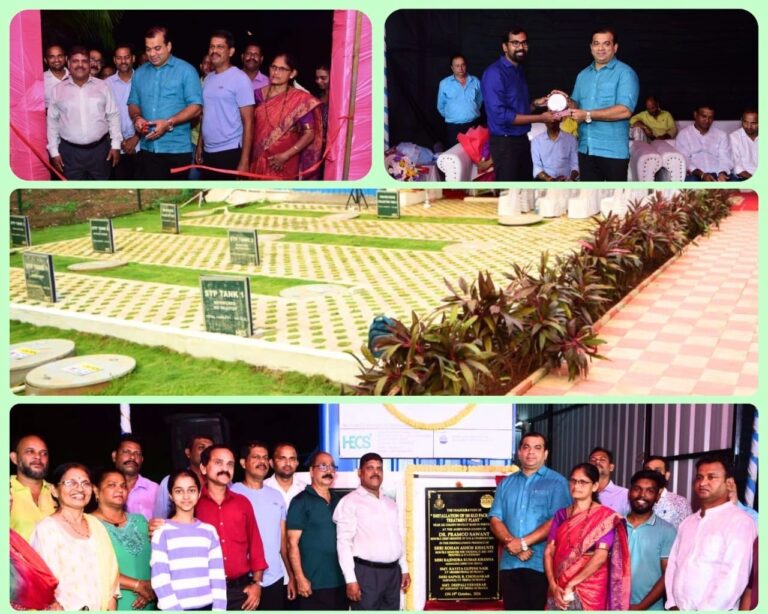
100 KLD packaged STP, Goa
Inaugurated by Goa's Minister of Tourism at Porvorim.
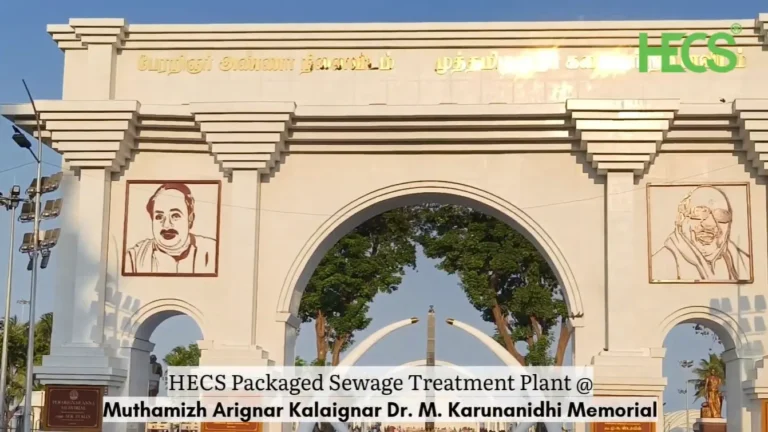
10 KLD packaged STP, Chennai
Installed at the Kalaignar Memorial, Chennai.
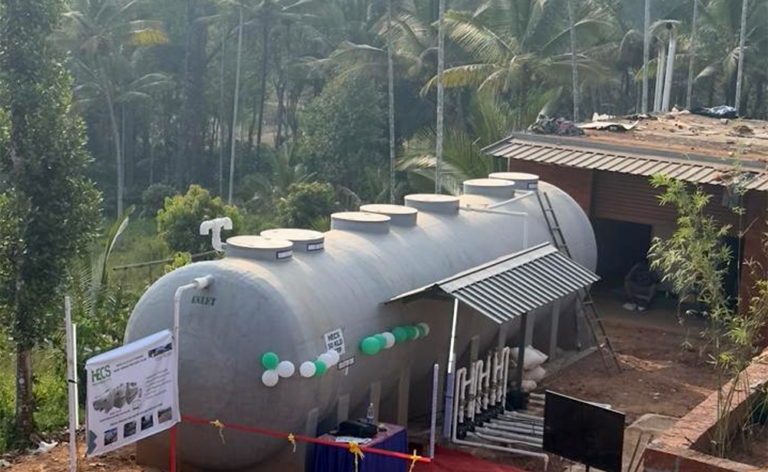
50 KLD smart STP, Wayanad
IoT-enabled plant for the Lords 83 resort.
Packaged STPs for GCC, Sri Lanka and international projects
Because HECS packaged STPs are pre-assembled and factory-tested, they suit export projects, labour camps, construction sites, hotels and residential compounds. Tell us your country, site and local discharge or reuse limits, and our engineers will size the plant and plan delivery and installation support.
- Saudi Arabia
- Kuwait
- UAE
- Qatar
- Oman
- Bahrain
- Sri Lanka
Frequently asked questions about packaged sewage treatment plants
What is a packaged sewage treatment plant?
A packaged sewage treatment plant (packaged STP or PSTP) is a compact, factory-built system that treats sewage on site so the water can be safely discharged or reused. It arrives pre-assembled and tested, needs little civil work and installs in days.
What is the difference between a packaged STP and a conventional STP?
A packaged STP is built and tested in a factory, then installed on site in days with little civil work. A conventional STP is built in concrete on site over several months and needs more land.
Which technology is best for a packaged STP: MBBR, SBR or MBR?
MBBR gives reliable, low-maintenance treatment, SBR is a cost-effective choice, and MBR gives the best water for reuse in the smallest space. HECS recommends the technology after checking your sewage quality, space, discharge norms and reuse plans.
What capacity packaged STP do I need?
Multiply the number of users by the water each person uses and by 0.8. For example, 100 flats x 5 residents x 135 litres x 0.8 = 54 KLD, so a 60 KLD plant is a sensible choice.
How much does a packaged sewage treatment plant cost in India?
The price depends on capacity, technology, treated-water quality, above- or below-ground installation, automation, site work and O&M. Every plant is sized for its site, so HECS gives a project-specific quote.
How long does it take to install a packaged STP?
Days rather than months, because the plant arrives pre-assembled and factory-tested. HECS Ultima units can be installed in about two days, followed by commissioning and start-up.
Can a packaged STP be installed underground?
Yes. HECS Ultima FRP units can be installed above or below ground, which helps where surface space is limited. Access covers are kept for inspection and maintenance.
Can treated water from a packaged STP be reused?
Yes. Treated water that meets the applicable norms is commonly reused for toilet flushing, gardening, irrigation and cooling towers. MBR plants give the highest-quality water for reuse.
What maintenance does a packaged STP need?
Daily checks of blowers, pumps and dosing, regular sludge removal, filter backwashing and periodic lab tests. HECS offers O&M and AMC contracts with IoT monitoring, so faults raise alerts early.
Does HECS supply packaged STPs outside India?
Yes. HECS supplies packaged sewage treatment plants for projects in the GCC, Sri Lanka and other countries. Share your country, site details and local discharge limits through the enquiry form or WhatsApp.
Get a packaged STP quote
Tell us about your project and our engineers will reply with a sized proposal. Please include:
- Project location and building type
- Number of users or daily water use
- Reuse needs (flushing, gardening, cooling)
- Space available, above or below ground