
Packaged Sewage Treatment Plant in Chennai - The Complete 2026 Buyer's Guide (STP Plant, FRP Treatment & Wastewater Solutions)
What Is a Packaged Sewage Treatment Plant? (And Why Chennai Needs Them)
If you manage a residential apartment, run a hotel, operate a hospital, or develop a commercial complex in Chennai — a Packaged Sewage Treatment Plant (Packaged STP) is not optional. It is a legal requirement.
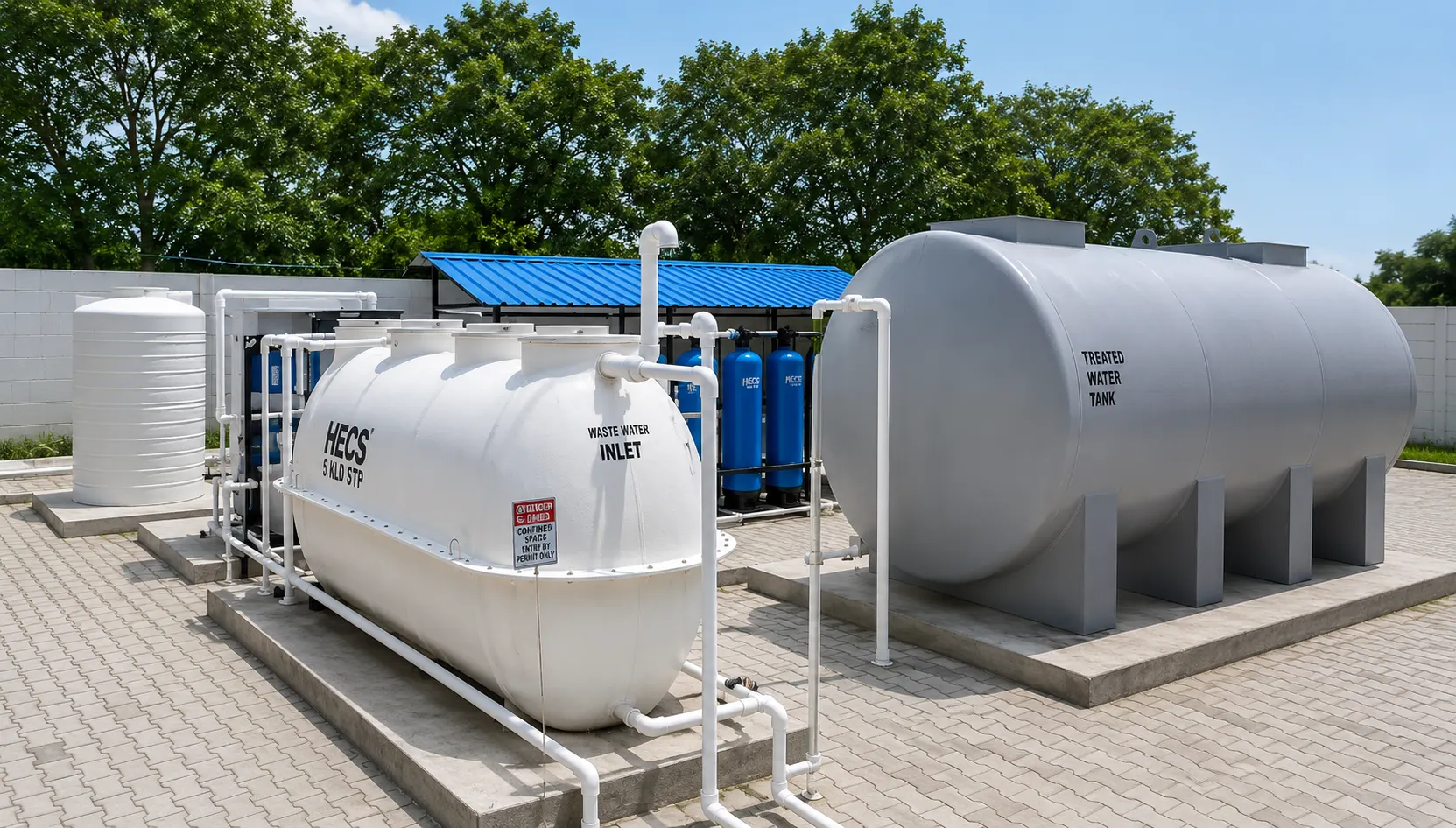
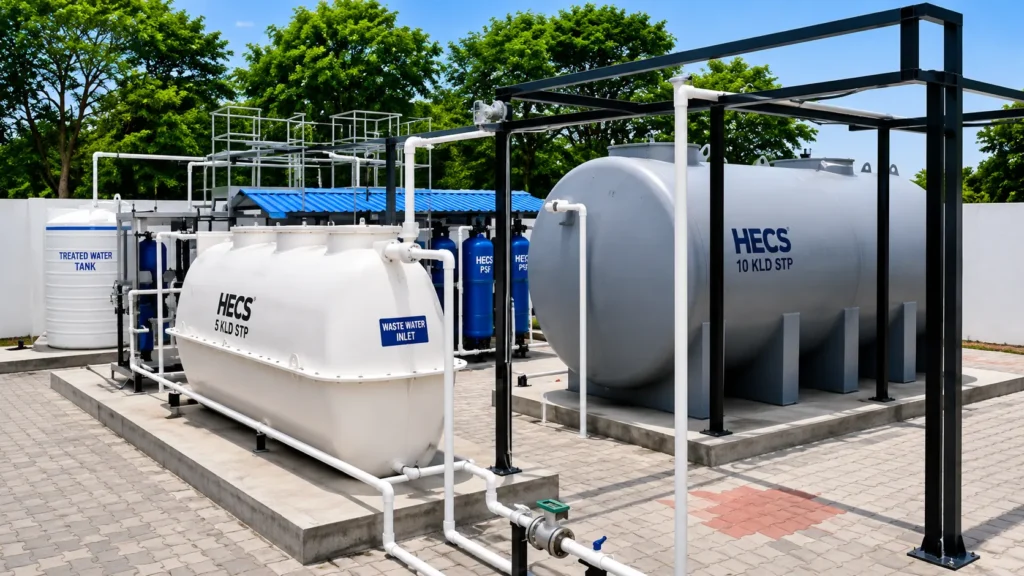
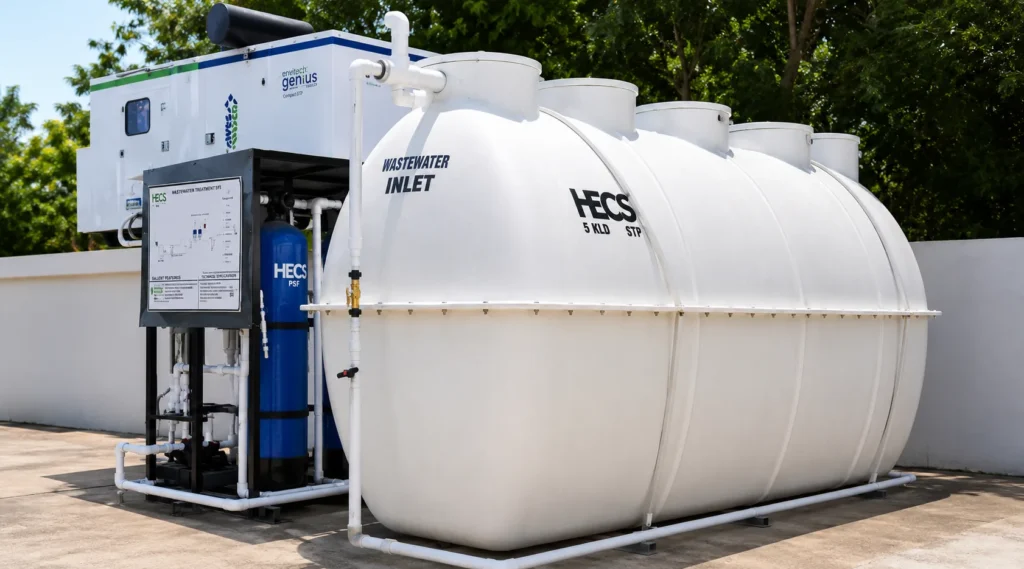
A Packaged STP is a compact, ready-to-install wastewater treatment system. Unlike conventional civil sewage treatment plants — which require large land areas, long construction timelines, and complex civil works — a packaged STP arrives at your site as a factory-built unit, typically housed in a FRP (Fibre Reinforced Plastic) or MS tank, ready for commissioning within days.
Chennai generates over 450 million litres of sewage per day. The city’s underground drainage system serves only a portion of its growing residential and commercial footprint. The rest falls on individual buildings and campuses to treat their own wastewater — which is precisely why the demand for packaged sewage treatment plants in Chennai and Tamil Nadu has grown dramatically over the past decade.
Whether you’re a builder in Perumbakkam, a hotel operator in T. Nagar, a pharma plant in Siruseri, or a school principal in Tambaram — this guide will explain everything you need to know about packaged STPs, FRP treatment systems, compliance requirements, and how to choose the right manufacturer.
Why Are Packaged STPs Mandatory in Tamil Nadu?
The Tamil Nadu Pollution Control Board (TNPCB) enforces strict regulations on sewage discharge. Under the Environment Protection Act, 1986, and in line with CPCB (Central Pollution Control Board) national standards, any building or campus generating more than a threshold volume of sewage is required to treat it before discharge or reuse.
Specifically in Tamil Nadu, the National Building Code (NBC) 2016 mandates STPs for:
- Residential buildings with more than 20 units or generating more than 10 KLD of sewage
- Hotels and resorts with over 50 rooms
- Hospitals and healthcare facilities of any significant size
- IT parks, SEZs, and commercial complexes above a certain built-up area
- Industrial campuses with domestic sewage generation
Chennai’s CMDA (Chennai Metropolitan Development Authority) building plan approvals now require an STP certificate before occupancy. Without a functioning, CPCB/TNPCB-compliant packaged STP, you cannot receive an Occupancy Certificate (OC) for your project.
This is the single most important compliance fact every builder, developer, and facility manager in Chennai must know.
Types of Packaged STP Technologies Available in Chennai
Not all sewage treatment plants are built the same. The right technology for your site depends on your capacity requirement, available space, reuse goals, and budget. Here is a plain-English breakdown of the main STP technologies offered by manufacturers in Chennai:
1. MBBR (Moving Bed Biofilm Reactor)
The most popular packaged STP technology in India today. MBBR uses plastic carrier media inside the reactor where bacteria grow and treat sewage continuously. It is compact, energy-efficient, and has low sludge generation.
- Best for: Residential apartments, schools, small commercial complexes
- Capacity range: 1 KLD to 500 KLD
- Key advantage: Low maintenance, suitable for fluctuating loads
2. MBR (Membrane Bioreactor)
MBR combines biological treatment with membrane filtration to produce treated water of very high quality — suitable for toilet flushing reuse and even garden irrigation. It is more expensive than MBBR but delivers superior output.
- Best for: Hospitals, hotels, IT parks, projects requiring high-quality reuse water
- Capacity range: 5 KLD to 1,000 KLD
Key advantage: Superior treated water quality (BOD < 5 mg/L, TSS < 5 mg/L)
3. SBR (Sequencing Batch Reactor)
SBR operates in batch cycles — filling, reacting, settling, and decanting in a single tank. It is highly flexible and suitable for variable flows.
- Best for: Industrial campuses, large residential townships
- Capacity range: 10 KLD to 2,000 KLD
- Key advantage: Flexible to flow variations, lower footprint than conventional plants
4. FRP (Fibre Reinforced Plastic) Packaged STP
FRP treatment refers to the housing material of the STP unit — not the treatment technology itself. FRP tanks are corrosion-resistant, lightweight, and long-lasting (20+ years). The treatment technology inside can be MBBR, MBR, or SBR. FRP-based packaged STPs are ideal for Chennai’s coastal climate where MS (mild steel) tanks can corrode rapidly.
- Best for: All applications in coastal Tamil Nadu locations
- Key advantage: Corrosion-resistant, no painting/maintenance required, aesthetically clean installation
HECS specialises in FRP-based packaged STPs using MBBR and MBR technologies — a combination specifically suited to Chennai’s coastal humidity and TNPCB reuse requirements.
STP Plant Capacity Guide: How Much Do You Need?
Choosing the right capacity (measured in KLD — Kilolitres per Day) is the first step in any STP project. Here is a quick reference based on Indian sewage generation standards:
|
Facility Type |
Sewage Generation Rate |
Example |
|
Residential Apartment |
135 litres/person/day |
100-flat complex = ~10–15 KLD |
|
Hotel (with restaurant) |
180 litres/room/day |
100-room hotel = ~20 KLD |
|
Hospital |
340 litres/bed/day |
50-bed hospital = ~17 KLD |
|
Office / IT Park |
45 litres/person/day |
500-seat office = ~25 KLD |
|
School / College |
45 litres/student/day |
1,000 students = ~45 KLD |
STP Plant Cost in Chennai — What to Budget in 2026
One of the most searched questions by builders and facility managers in Chennai: “How much does a packaged STP cost in Tamil Nadu?”
Here is a realistic cost reference for 2026 (indicative, varies by technology and site conditions):
Capacity | Technology | Approximate Cost Range |
1–2 KLD | MBBR / FRP | ₹1.8L – ₹3.5L |
5 KLD | MBBR / FRP | ₹4L – ₹6.5L |
10 KLD | MBBR / MBR | ₹8L – ₹14L |
25 KLD | MBR / SBR | ₹18L – ₹28L |
50 KLD | MBR / SBR | ₹32L – ₹48L |
100 KLD | MBR / SBR | ₹55L – ₹90L |
250 KLD+ | SBR ,MBR,MBBR/ Custom | Custom quote |
Important: These are supply-and-install estimates including commissioning. Civil work (foundation, inlet chamber) is typically extra. AMC (Annual Maintenance Contract) costs are separate and range from ₹20,000–₹2,00,000 per year depending on capacity.
Get an accurate quote specific to your Chennai project: Fill the inquiry form below with your capacity requirement, building type, and location — HECS provides free site assessments and budgetary estimates within 24 hours.
TNPCB Compliance Standards for STPs in Tamil Nadu
Every STP installed in Chennai and Tamil Nadu must meet the following treated water quality standards set by TNPCB in line with CPCB norms:
|
Parameter |
Standard for Discharge into Drains |
Standard for Reuse (Flushing/Irrigation) |
|
BOD (Biological Oxygen Demand) |
< 30 mg/L |
< 10 mg/L |
|
COD (Chemical Oxygen Demand) |
< 250 mg/L |
< 50 mg/L |
|
TSS (Total Suspended Solids) |
< 100 mg/L |
< 10 mg/L |
|
pH |
6.5 – 9.0 |
6.5 – 8.5 |
|
Faecal Coliform |
< 1000 MPN/100 mL |
< 200 MPN/100 mL |
MBR-based packaged STPs consistently achieve reuse-grade treated water, making them the preferred technology for projects seeking LEED certification, green building ratings, or OC compliance in Chennai.
CPCB Approval: HECS PSTP’s packaged STPs are designed to meet CPCB’s general standards for discharge and are compliant with Tamil Nadu’s Sewage Generation and Treatment norms.
IoT-Enabled STPs — The Future of Wastewater Management in Chennai
Traditional STP management in Chennai has a recurring problem: operator-dependent reliability. When operators don’t show up or systems aren’t monitored regularly, STPs fail silently — resulting in non-compliant discharge and TNPCB notices.
HECS PSTP is India’s first manufacturer of IoT-enabled packaged sewage treatment plants, featuring the SmartHub monitoring platform. Here is what IoT adds to your STP:
- Real-time remote monitoring of DO (dissolved oxygen), BOD, flow rates, and blower status from your phone
- Automated alerts for equipment failure, power cuts, or treated water quality deviation
- Data logs for TNPCB compliance reporting — no manual record keeping required
- Predictive maintenance — reduces emergency breakdowns and extends equipment life
- Centralised dashboard for facility managers overseeing multiple buildings or campuses
For housing societies in Chennai managing 200+ flats, IoT-enabled STPs mean less dependence on a single operator and far greater compliance assurance. For hotels and hospitals, it means uninterrupted treated water quality for reuse — which directly impacts costs.
Why Chennai Projects Specifically Need a Local STP Manufacturer
Choosing a Chennai-based or Tamil Nadu-experienced STP manufacturer is not just a preference — it is a practical advantage:
1. TNPCB Documentation Support
Local manufacturers like HECS understand TNPCB submission formats, consent applications, and compliance reporting requirements specific to Tamil Nadu. National manufacturers unfamiliar with TNPCB processes leave clients scrambling at approval stage.
2. Faster Installation and Commissioning
A manufacturer with a local team in Chennai means faster delivery, quicker troubleshooting, and on-ground support without waiting for engineers to fly in from another state.
3. Coastal Climate Expertise
Chennai’s coastal humidity accelerates corrosion in MS tanks and blower components. Manufacturers with Tamil Nadu experience specify FRP tanks and corrosion-resistant fittings by default — saving clients expensive replacements within 5–7 years.
4. Knowledge of Local Soil and Infrastructure Conditions
Chennai’s soil types vary significantly across zones — sandy coastal soil in Ennore, black cotton soil in parts of Poonamallee, hard rock in Perungalathur. Experienced local STP partners design installations that account for these site-specific conditions.
5. References and Track Record in the Region
An STP manufacturer with multiple installations in Chennai and Tamil Nadu can provide references you can visit or call — reducing project risk significantly.
HECS PSTP — Packaged STP Manufacturer Based in Chennai
HECS PSTP is headquartered in Chennai, Tamil Nadu, and is one of India’s most experienced packaged sewage treatment plant manufacturers with over 25 years of operations and 7,000+ successful installations across India.
Why HECS for Your Chennai STP Project?
- India’s 1st IoT-enabled STP — SmartHub remote monitoring platform
- CPCB-compliant across all product lines
- Full capacity range: 1 KLD to 1,000 KLD+ — one vendor for any scale
- FRP-based packaged STPs designed for Tamil Nadu’s coastal climate
- Technologies offered: MBBR, MBR, SBR, Disc Rotating Biocontactor (DRB)
- Specialist verticals: Residential, hospitality, healthcare, pharmaceutical, industrial
- Tamil Nadu track record: Schools, hospitals, hotels, residential complexes, industrial parks
- Complete lifecycle support: Design → Supply → Install → Commission → AMC
MBR-based packaged STPs consistently achieve reuse-grade treated water, making them the preferred technology for projects seeking LEED certification, green building ratings, or OC compliance in Chennai.
CPCB Approval: HECS PSTP’s packaged STPs are designed to meet CPCB’s general discharge standards and are compliant with Tamil Nadu’s Sewage Generation and Treatment norms.
HECS Product Line — STP Solutions for Every Need
Product | Technology | Best Application |
HECS Ultima Series | MBBR | Residential apartments, schools, small commercial |
HECS Amaze MBR | MBR | Hospitals, hotels, IT parks, reuse-grade output required |
HECS X-FLUENT | FRP Packaged ETP | Townships, industrial campuses, municipalities |
MediClear | MBR + Advanced | Hospitals and pharma effluent treatment |
SmartHub-enabled | Any technology | IoT monitoring overlay for any packaged STP |
Case Studies — HECS STP Installations Across Tamil Nadu
Residential Complex, Chennai (OMR Corridor) — 50 KLD MBR STP
A 350-unit premium apartment complex on the OMR Tech Corridor required a compact STP within a constrained basement space. HECS designed and installed a 50 KLD HECS Amaze MBR system in an FRP configuration within the stilt parking area. The system delivers treated water meeting TNPCB reuse standards for 100% toilet flushing — reducing the complex’s CMWSSB water consumption by 35%.
Hospital, Coimbatore — 30 KLD MediClear ETP/STP
A 200-bed hospital in Coimbatore needed simultaneous treatment of domestic sewage and laboratory effluent. HECS installed a 30 KLD MediClear system — a combination MBR + advanced disinfection unit — that meets TNPCB healthcare discharge standards while complying with the facility’s NABH requirements.
Industrial Campus, Siruseri IT Park, Chennai — 100 KLD SBR STP
An IT park in Siruseri with 4,000 employees needed a reliable STP with centralised monitoring for multiple buildings. HECS installed a 100 KLD SBR-based packaged STP with SmartHub IoT integration, enabling the facility manager to monitor all five buildings’ STP performance from a single dashboard.
How to Get a Packaged STP Installed in Chennai — Step-by-Step
Here is the typical process for a new STP installation in Chennai or Tamil Nadu:
Step 1 — Site Assessment & Capacity Calculation
HECS engineers visit your site, assess sewage generation, available space, inlet point, and treated water reuse plan. A detailed capacity recommendation is provided.
Step 2 — Proposal & Design
A detailed proposal with P&ID drawings, equipment specifications, STP layout, and cost breakdown is submitted. Multiple technology options (MBBR vs MBR vs SBR) are presented with a clear recommendation.
Step 3 — TNPCB / CMDA Documentation Support
HECS assists with preparing the STP technical report required for TNPCB consent to operate and CMDA building plan submissions, including treated water quality guarantees.
Step 4 — Manufacturing & Delivery
FRP-based packaged STP units are manufactured at HECS’s facility and delivered to your Chennai site. Delivery typically takes 3–6 weeks depending on capacity.
Step 5 — Installation & Commissioning
HECS’s installation team commissions the STP on-site, seeds the biological media, runs trial operations, and hands over the system with a performance guarantee.
Step 6 — AMC & Monitoring
Optional Annual Maintenance Contract (AMC) with monthly service visits, operator training, spare parts support, and SmartHub IoT monitoring subscription.
Get a Free Quote for Your Chennai STP Project
Whether you need a 1 KLD packaged STP for a small apartment, a 100 KLD MBR plant for a hospital, or a 500 KLD SBR system for an industrial campus — HECS PSTP provides a free site assessment and budgetary proposal within 24 hours.
Conclusion
The demand for packaged sewage treatment plants in Chennai and Tamil Nadu will only grow as TNPCB tightens enforcement, CMDA mandates OC compliance, and groundwater depletion makes treated water reuse economically essential.
The decision that matters most is not whether to install an STP — that is non-negotiable in today’s regulatory environment. The decision is which technology, which capacity, and which manufacturer to trust.
With 25+ years of experience, 7,000+ installations, India’s first IoT-enabled packaged STP, and a headquarters right here in Chennai, HECS PSTP is the partner of choice for builders, developers, hospitals, hotels, and facility managers across Tamil Nadu.
Start your STP project today — contact HECS for a free consultation.
Build a Greener Future – Connect with HECS Now!
Looking for reliable wastewater treatment solutions? Get expert guidance and find the perfect STP for your needs today!
Frequently Asked Questions - About Packaged STPs in Chennai
1. Is a packaged STP mandatory for apartments in Chennai?
Yes. Under CMDA and TNPCB regulations, residential buildings generating more than 10 KLD of sewage (approximately 70–80 flats) must have a functional STP before receiving an Occupancy Certificate. Many banks and financial institutions also require STP compliance documentation for housing loan approvals.
2. What is the difference between a packaged STP and a conventional STP?
A conventional STP involves civil construction (tanks, chambers, aeration basins built on-site). A packaged STP is factory-built, pre-wired, and pre-tested — significantly reducing installation time and on-site civil work. Packaged STPs are also more compact, making them suitable for space-constrained urban sites like Chennai apartments.
3. What is an FRP treatment plant and is it better than an MS STP?
Which STP technology is best for apartments in Chennai?FRP (Fibre Reinforced Plastic) refers to the tank material. FRP does not corrode, requires no painting, and withstands Chennai’s high humidity and coastal salt-laden air for 20+ years. MS (Mild Steel) tanks corrode within 5–10 years in coastal environments and require regular repainting. For Chennai projects, FRP-based packaged STPs are the recommended choice.
4. How long does it take to install a packaged STP in Chennai?
For a 10–50 KLD FRP packaged STP, on-site installation and commissioning typically takes 5–10 days once the unit arrives. Delivery from the manufacturer takes 3–6 weeks. Total project timeline from order to commissioning is typically 6–10 weeks.
5. Can STP-treated water be reused for flushing in Chennai apartments?
Yes — provided the STP produces treated water meeting TNPCB reuse standards (BOD < 10 mg/L, TSS < 10 mg/L, Faecal Coliform < 200 MPN/100mL). MBR-based packaged STPs routinely achieve this quality. Treated water reuse for toilet flushing can reduce a Chennai apartment complex’s municipal water consumption by 25–35%.
6. Does HECS provide service and maintenance in Chennai?
Yes. HECS is headquartered in Chennai and provides Annual Maintenance Contracts (AMC) covering monthly service visits, consumable replacements (membranes, media), operator training, and emergency support. SmartHub IoT monitoring provides 24/7 remote performance visibility.
7. What TNPCB approvals are required for an STP in Tamil Nadu?
Depending on project category, facilities require: (a) Consent to Establish (CTE) before construction, (b) Consent to Operate (CTO) after commissioning. HECS provides technical documentation support for both submissions, including STP performance guarantees accepted by TNPCB.
8. Which STP technology is best for apartments in Chennai?
MBBR (Moving Bed Biofilm Reactor) and MBR (Membrane Bioreactor) are among the most widely preferred technologies. MBBR offers reliable treatment with lower operational complexity, while MBR provides superior treated water quality suitable for extensive reuse applications. The best technology depends on project size, available space, reuse requirements, and operational preferences.
9. What is the cost of a packaged STP in Chennai?
The cost of a packaged STP depends on capacity, treatment technology, automation level, tank material, and reuse requirements. Small apartment STPs typically have lower capital costs, while advanced MBR systems with automation and IoT monitoring involve higher initial investment but can reduce long-term operating expenses through water reuse and efficient performance.
10. Does HECS provide STP operation, maintenance, and AMC services in Chennai?
Yes. HECS provides complete after-sales support including Annual Maintenance Contracts (AMC), preventive maintenance, operator training, spare parts support, performance monitoring, membrane replacement, troubleshooting, and 24/7 remote monitoring through SmartHub IoT solutions. This helps ensure consistent STP performance and regulatory compliance throughout the system lifecycle.