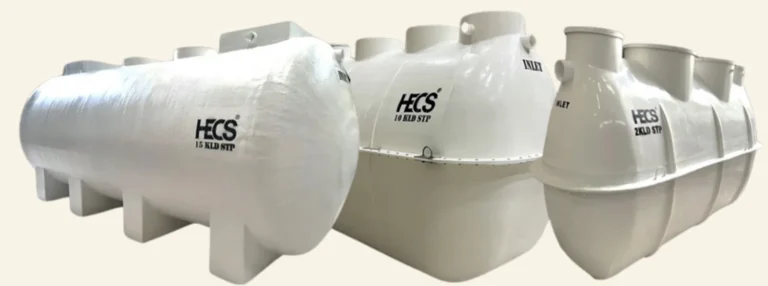
In short: HECS makes filament wound FRP tanks (seamless, factory-built, for above- or below-ground installation) and SMC panel tanks (modular, assembled on site, 10 m³ to 5,000 m³) for potable water, fire water, chemicals, oil and wastewater. Made at our 2.5-acre factory at SIPCOT Vallam Vadagal, Sriperumbudur, Chennai.
Two tank technologies, one supplier

What is a filament wound FRP tank? A seamless tank made by winding resin-soaked glass fibre on a mandrel in the HECS factory. The result is uniform strength, no joints, and a tank that is unaffected by UV, heat or biological growth.
- Seamless, factory-built at our Chennai plant
- Above- or below-ground installation
- Corrosion-resistant, no liners or coatings needed
- Installed in a couple of days
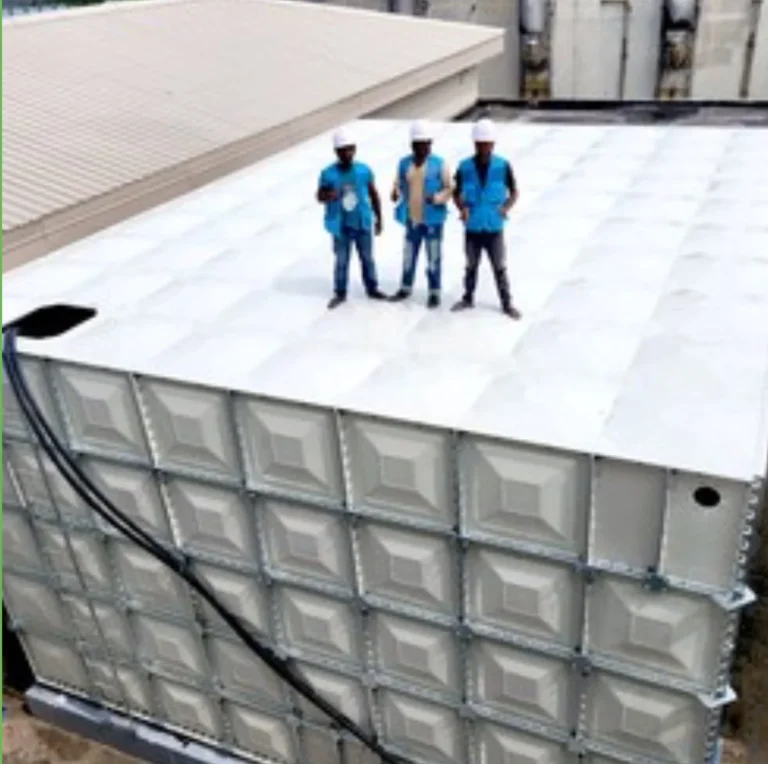
What is an SMC panel tank? A modular tank built on site from hot-pressed SMC (sheet moulding compound) panels. The panels block light, algae and germs, and special sealing tape keeps the tank watertight.
- 10 m³ to 5,000 m³ capacity, 1.0–5.0 m high
- Cube, corner and odd-shaped (L, U) layouts
- Assembled on site, relocatable
- 40-year design life of SMC material
Filament wound FRP tank or SMC panel tank?
| Filament wound FRP tank | SMC panel tank | |
|---|---|---|
| Construction | Seamless; resin-soaked fibre wound on a mandrel | Modular hot-pressed panels, assembled on site |
| Capacity | Sized to your project | 10 m³ to 5,000 m³; larger tanks by separate design |
| Height | As designed | 1.0 m to 5.0 m |
| Installation | Above or below ground; installed in a couple of days | Rooftop, basement or ground; easy to assemble and relocate |
| Shapes | Horizontal or vertical cylinder | Cube, corner and odd-shaped (L, U) layouts |
| Best for | Underground sumps, sewage and chemical storage, sites needing a ready tank | Large reserve tanks, rooftops and basements with narrow access |
| Hygiene | Non-porous; no liners needed | Panels block light, algae and germs |
| Design life | Long life; unaffected by UV, heat or biological growth | 40-year design life of SMC material |
Not sure which suits you? Share the use, volume and space, and we will recommend the type and size.
SMC panel tank sizes: 10 m³ to 5,000 m³
1 m³ = 1 KL = 1,000 litres. SMC tank volume is length × width × height; panels of different sizes let us fit the tank to your space, at heights from 1.0 m to 5.0 m. Example layouts:
| Capacity | Litres | Typical use | Example size (L × W × H) |
|---|---|---|---|
| 10 m³ | 10,000 | Villas, small offices, treated water from a 10 KLD STP | 3 × 2 × 2 m (12 m³) |
| 50 m³ | 50,000 | Apartments, hotels, hospitals, fire water reserve | 4 × 4 × 3 m (48 m³) |
| 100 m³ | 1,00,000 | Gated communities, IT parks, factories | 6 × 6 × 3 m (108 m³) |
| 500 m³ | 5,00,000 | Townships, campuses, industrial process water | 12 × 10 × 4 m (480 m³) |
| 1,000 m³ | 10,00,000 | Large industry, municipal reserves | 16 × 16 × 4 m (1,024 m³) |
| 5,000 m³ | 50,00,000 | Very large reserves; larger by separate design | 32 × 32 × 5 m (5,120 m³) |
Tip for STP treated water: store at least one day of output, so a 50 KLD STP needs about a 50 m³ tank. Estimate your daily flow with the capacity calculator.
Built for every kind of liquid storage
Filament wound FRP tanks: strong, seamless and built to last
Civil (RCC) tank vs HECS FRP tank
| Aspect | Civil (RCC) tank | HECS filament wound FRP tank |
|---|---|---|
| Installation time | Long, labour-intensive, needs curing | Quick, factory-finished, minimal site work |
| Strength and durability | Strong in compression, cracks over time | High tensile strength, crack-resistant |
| Corrosion resistance | Moisture and chemical degradation | Excellent chemical and corrosion resistance |
| Maintenance | Frequent sealing, patching, repairs | Very low maintenance |
| Cost efficiency | Lower initial cost, higher long-term cost | Higher upfront cost, lower life-cycle cost |
More in our comparison FRP vs RCC.
SMC panel tanks: hygienic, watertight and modular
Ten reasons to choose HECS tanks
Tanks are made at our 2.5-acre facility at SIPCOT Vallam Vadagal, Sriperumbudur, Chennai, with filament winding, a dedicated factory floor and in-house dispatch. Head office: TVK Industrial Estate, Guindy, Chennai.
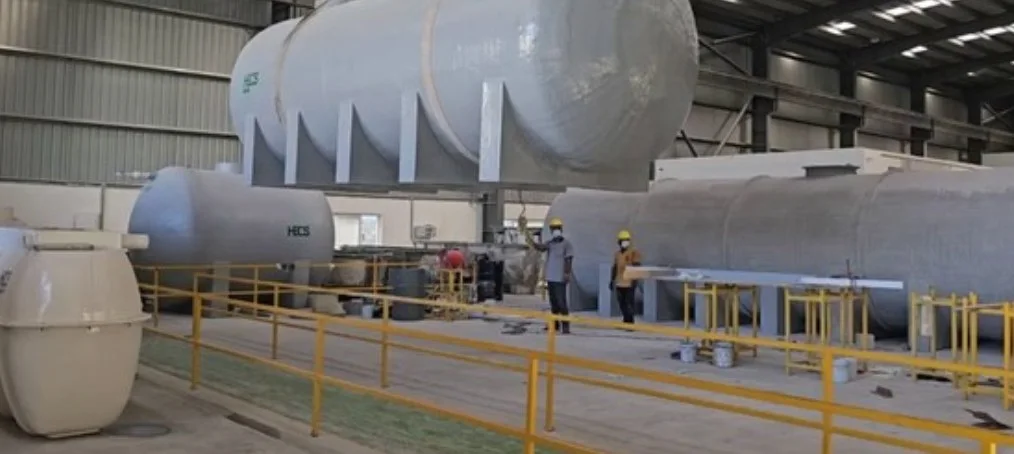

How we supply and install your tank
Beyond storage: HECS packaged treatment plants
Need treatment as well as storage? HECS packaged plants pair with our tanks on the same project.
Get a size and quote for your FRP or SMC tank
Tell us about your requirement and an HECS engineer will reply with a recommended tank type, size and layout. Helpful to include:
- Liquid: potable, fire, chemical, oil or wastewater
- Volume needed (m³ or litres)
- Location: rooftop, basement, ground or below ground
- Site city and access
- Preferred type: FRP or SMC, if known
Size at a glance: 1 m³ = 1,000 litres. SMC tanks: 10 m³ to 5,000 m³, 1.0–5.0 m high. For treated water, plan at least one day of STP output.
Prefer to talk?
Hubert Enviro Care Systems, A21, 3rd Phase, TVK Industrial Estate, Guindy, Chennai 600032. Your details are used only to respond to this enquiry.
FRP and SMC storage tanks: common questions
Can’t find your answer? Ask an HECS engineer. We reply within minutes.
What is the difference between a filament wound FRP tank and an SMC panel tank?
A filament wound FRP tank is a seamless tank made in the HECS factory by winding resin-soaked glass fibre on a mandrel. An SMC panel tank is assembled on site from hot-pressed panels, so its size and shape can fit any space.
What capacities do HECS SMC panel tanks come in?
From 10 m³ to 5,000 m³, at heights from 1.0 m to 5.0 m. Larger tanks are possible by separate design.
Can HECS FRP tanks be installed underground?
Yes. Filament wound FRP tanks are installed above or below ground, and can be designed to sit under traffic load.
Are HECS tanks suitable for drinking water?
Yes. HECS tanks are 100% hygienic and suitable for water, non-porous, and the SMC panels block light, algae and germs.
How long do FRP and SMC tanks last?
FRP tanks are unaffected by UV, heat or biological growth and do not rust. SMC material has a 40-year design life.
How long does installation take?
A filament wound FRP tank is factory-finished and installed in a couple of days. SMC tanks are simple to assemble on site.
Which liquids can HECS tanks store?
Potable, waste and process water, fire water, fuels and oils, acids, alkalis and solvents, saltwater, and wastewater.
Is an FRP tank better than an RCC tank?
FRP costs more upfront but less over its life: it installs quickly, resists cracks and corrosion, and needs very little maintenance, while RCC needs curing and frequent repairs.
Need a water, fire or chemical storage tank?
Filament wound FRP or SMC panel, above or below ground. Tell us the liquid and volume, and get a recommendation and quote from HECS.
