
Packaged sewage treatment plants for factories, industrial parks and worker housing
An industrial packaged sewage treatment plant (industrial packaged STP) is a factory-built system that treats the domestic sewage a factory or industrial site generates (from toilets, washrooms, canteens and worker housing) so it can be discharged within consent limits or reused on site. It is not designed for process effluent, which needs an ETP.
Hubert Enviro Care Systems (HECS), Chennai, has made packaged STPs since 1997. Its FRP plants use MBBR (HECS Ultima) or MBR (HECS Amaze) technology, are sized to your shifts, canteen and housing load, and can be monitored remotely through HECS SmartHub.
- Factory-built FRP
- MBBR or MBR
- SmartHub IoT monitoring
- Installation, O&M and AMC
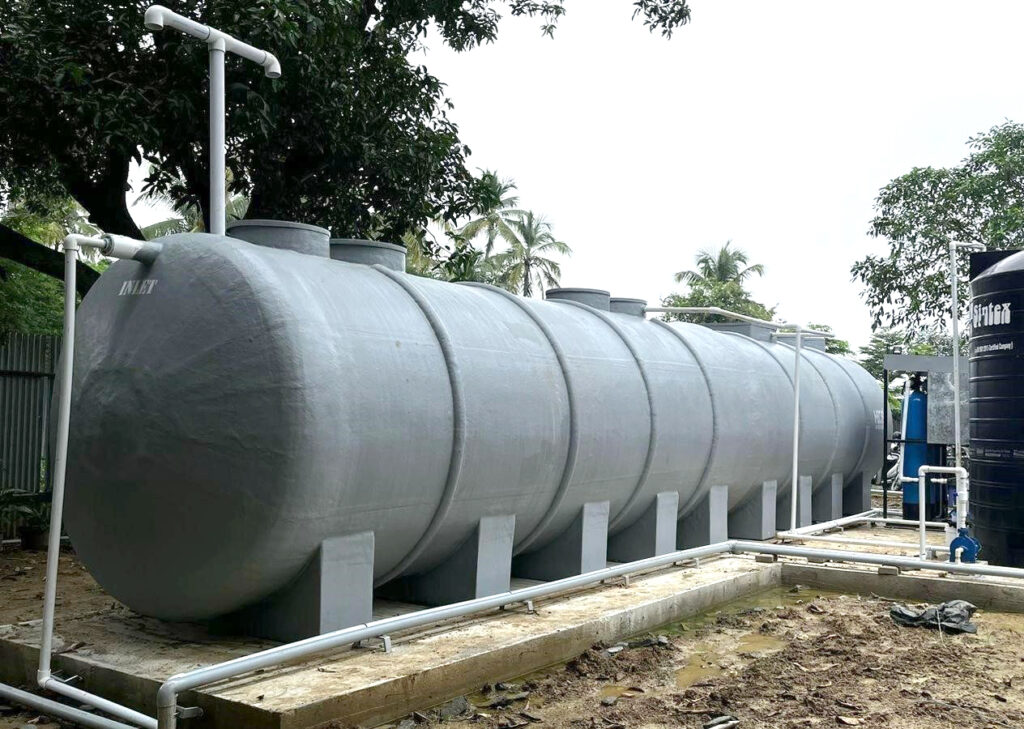
Hubert Enviro Care Systems, Chennai
HECS Ultima, Ultima+ and Amaze plants
remote monitoring, alerts and reports
both streams from one engineering team
What is an industrial packaged STP?
It is a complete sewage treatment plant, from screening to disinfection, built inside FRP tanks in a factory and delivered ready to connect. It treats the domestic sewage every industrial site produces, regardless of what the site manufactures. Because the plant is built and tested off site, it needs far less civil work than a concrete STP, can sit above or below ground, and can be expanded with extra modules as headcount grows.
For the full technology and size guide, see packaged sewage treatment plants.
Key facts
- Treats: domestic sewage from staff toilets, washrooms, canteens and worker housing
- Does not treat: process effluent; that needs a packaged or customised ETP
- Technology: MBBR (HECS Ultima, Ultima+) or MBR (HECS Amaze)
- Construction: FRP, factory-built and tested; minimal civil work; above or below ground
- Monitoring: IoT through HECS SmartHub (Ultima+ SMART and Amaze)
- Also called: packaged STP for factories, modular, prefabricated or compact industrial STP
Does your factory need an STP, an ETP or both?
In short: sewage goes to an STP, process effluent goes to an ETP, and most manufacturing plants need both as separate systems.
| What you need to treat | Typical sources in a factory | What treats it | HECS option |
|---|---|---|---|
| Domestic sewage only | Toilets, washrooms, bathing, canteen and kitchen, worker housing | Packaged STP (biological treatment) | HECS Ultima (MBBR) or HECS Amaze (MBR) |
| Process effluent only | Washing, cooling blowdown, plating, dyeing, painting, chemical or pharma processes | ETP designed for that effluent after analysis | Customised packaged ETP or HECS X-FLUENT |
| Both streams | Most manufacturing plants | Separate STP and ETP, sized independently. Streams are combined only if a treatability study shows it is safe | Example: 6 KLD STP + 20 KLD ETP, Global Pharma |
| Canteen water with oil and grease | Large kitchens and canteens | Oil and grease trap before the STP | Included in HECS STP design when needed |
Why it matters: a sewage STP relies on bacteria. Oils, solvents, heavy metals, high-TDS or toxic process streams can kill that biology and push the outlet out of your consent limits. Keep process drains out of the STP unless an engineer has checked the effluent. Not sure what your drains carry? Share your process details and HECS engineers will advise which treatment each stream needs.
Where industrial packaged STPs are used
Any site where people work or live and there is no sewer connection, or where the consent requires on-site treatment.
Manufacturing plants
Sewage from shop-floor washrooms, canteens and admin blocks, sized to shifts and headcount.
Automobile and engineering units
Domestic sewage kept separate from oily or painting effluent, which goes to an ETP.
Pharma and food processing
STP for the sewage stream alongside a dedicated ETP for process water.
Industrial parks and SEZs
Plants for common amenities, offices and tenant blocks where central sewers are absent.
Warehouses and logistics parks
Compact plants for staff and driver amenities on sites without sewer connections.
Worker housing and campuses
Labour colonies, hostels and staff quarters with steady 24-hour sewage flow.
How do you size an STP for a factory?
In short: design flow comes from how many people use the site, for how long, and how much water they actually use, plus peaks at shift changes and room for growth. Real water records beat rules of thumb.
Send the inputs in the table and HECS engineers calculate the capacity in KLD, the peak factor and the process. For a first estimate, use the calculator.
| Input HECS asks for | Why it changes the design |
|---|---|
| Employees per shift and number of shifts | Sets the daily volume and how sharply flow peaks at shift changes |
| Canteen: meals per day, kitchen on site? | Adds flow and oil and grease; may need a grease trap |
| Worker housing or hostels on site | Residents use more water than shift staff and create 24-hour flow |
| Water meter or bore-well records | The most reliable basis for sewage volume; estimates are used only when records are missing |
| Known inlet quality (BOD, COD, TSS, oil and grease) | Drives the biological stage size and pretreatment |
| Discharge point and SPCB consent limits | Fixes the outlet quality the plant must meet |
| Reuse plans (flushing, gardening, cooling, washing) | May need tertiary filtration, disinfection or MBR |
| Space, ground conditions, power and future expansion | Decides above- or below-ground, footprint and modular expansion |
How an industrial packaged STP treats sewage
Six stages, configured to your load and consent limits. HECS chooses between MBBR and MBR after reviewing the inputs above.
1. Screening and grease removal
Bar screen removes solids; an oil and grease trap handles canteen water where needed.
2. Equalisation
Evens out shift-change peaks so the biological stage gets a steady load.
3. Biological treatment
Bacteria break down organic load in MBBR reactors (Ultima) or an aerated tank with membranes (Amaze).
4. Solids separation
A settling stage (MBBR) or submerged membranes (MBR) separate clear water from biomass.
5. Tertiary and disinfection
Pressure sand and activated carbon filters and dosing (Ultima+), then disinfection for reuse.
6. Sludge handling
Excess sludge is recycled or removed to a sludge bag or drying system for disposal.
HECS packaged STP options for industry
| HECS plant | Technology | Treated water, design values (mg/l) | Best for |
|---|---|---|---|
| HECS Ultima | Hybrid MBBR, FRP | BOD < 20, TSS < 50 | Discharge within standard limits, lowest running cost |
| HECS Ultima+ | Hybrid MBBR + pressure sand filter, activated carbon filter, bag filter, dosing | BOD < 10, TSS < 20 | Stricter consent limits, reuse for flushing and gardening |
| HECS Ultima+ SMART | Ultima+ with IoT control panel and SmartHub app | As Ultima+ | Sites without a full-time operator; multi-site oversight |
| HECS Amaze | MBR with Mitsubishi membranes | BOD < 5, COD < 30, TSS < 5 | Tight sites, strict norms, high reuse targets |
Source: HECS packaged STP brochure (2026). Design values for typical domestic sewage; actual results depend on inlet quality, loading and operation. Capacity, footprint and power are confirmed in each technical proposal.
Packaged STP or conventional concrete STP?
For most single-site industrial sewage loads, a packaged plant is faster to deliver and easier to expand. A conventional plant can still make sense for very large flows or when a central plant is already planned.

| Packaged STP (HECS) | Conventional RCC STP | |
|---|---|---|
| Where it is built | In the factory, tested before dispatch | On site, in reinforced concrete |
| Site work | Minimal civil work: foundation or pit, connections | Excavation, formwork and curing over months |
| Footprint | Compact; above or below ground | Larger; usually needs dedicated land |
| Expansion | Add modules as headcount grows | Major civil work to expand |
| Relocation | Units can be moved if the plant layout changes | Fixed |
| Monitoring | IoT through SmartHub on Ultima+ SMART and Amaze | Usually manual checks |
| Best fit | Most single-site industrial sewage loads | Very large flows or where a central plant is already planned |
From enquiry to a running plant, then O&M
1. Requirement and site data
Headcount, shifts, canteen, housing, water records, consent limits and site photos.
2. Site survey and sampling
HECS engineers check space, levels, drains and the consent limits for your site.
3. Technical proposal
Capacity, process, layout, utilities and a detailed quotation with O&M options.
4. Factory build and testing
The FRP plant is fabricated and tested before dispatch while civil work runs in parallel.
5. Install, commission, hand over
Installation, biological start-up and handover to your operators.
What HECS O&M and AMC cover
- Routine operation checks and preventive maintenance of blowers, pumps and dosing
- Sludge removal scheduling and filter backwash routines
- SmartHub alerts and performance reports for Ultima+ SMART and Amaze plants
- Annual maintenance contracts (AMC), spares and breakdown support
- Upgrades of existing manual or conventional STPs (see the Interarch project)
Existing STP failing or hard to run? See how HECS upgraded Interarch’s conventional STP.
Reusing treated sewage on site
Treated sewage can replace fresh water for non-potable uses, subject to your consent conditions and the reuse quality required:
- Toilet and urinal flushing
- Gardening and landscaping
- Floor and vehicle washing
- Cooling tower make-up, usually after extra treatment and a water-quality check
Higher reuse targets usually point to Ultima+ with tertiary filters or to Amaze MBR.
Consent and discharge standards
Most industrial units need Consent to Establish (CTE) and Consent to Operate (CTO) from their State Pollution Control Board, and the STP outlet limits written in that consent are the ones your plant must meet.
National discharge standards for STPs, notified by MoEF&CC (G.S.R. 1265(E), 13 October 2017):
| Parameter | Metro cities* and state capitals | Other areas |
|---|---|---|
| pH | 6.5–9.0 | 6.5–9.0 |
| BOD (mg/l) | 20 | 30 |
| TSS (mg/l) | < 50 | < 100 |
| Faecal coliform (MPN/100 ml) | < 1,000 | < 1,000 |
*Mumbai, Delhi, Kolkata, Chennai, Bengaluru, Hyderabad, Ahmedabad and Pune. State capitals of the north-eastern and hill states named in the notification, and some union territories, follow the "other areas" column. The limits apply to STPs commissioned on or after 1 June 2019. The faecal coliform limit does not apply where treated water is used for industrial purposes. CPCB and State Pollution Control Boards may set stricter norms. Source: CPCB copy of the Gazette notification.
HECS design values for typical domestic sewage are BOD < 20 and TSS < 50 mg/l (Ultima), BOD < 10 and TSS < 20 mg/l (Ultima+) and BOD < 5 and TSS < 5 mg/l (Amaze). HECS designs each plant to the limits in your consent and the reuse you plan. See also our STP discharge standards guide and STP regulations by state.
HECS industrial STP and ETP projects
Named projects from HECS’s case studies. Each page shows the scope and the problem solved.

30 KLD Ultima+ Smart STP, Interarch
Upgrade of a manual, conventional STP at Interarch Building Products' manufacturing facility to an automated plant with remote monitoring.
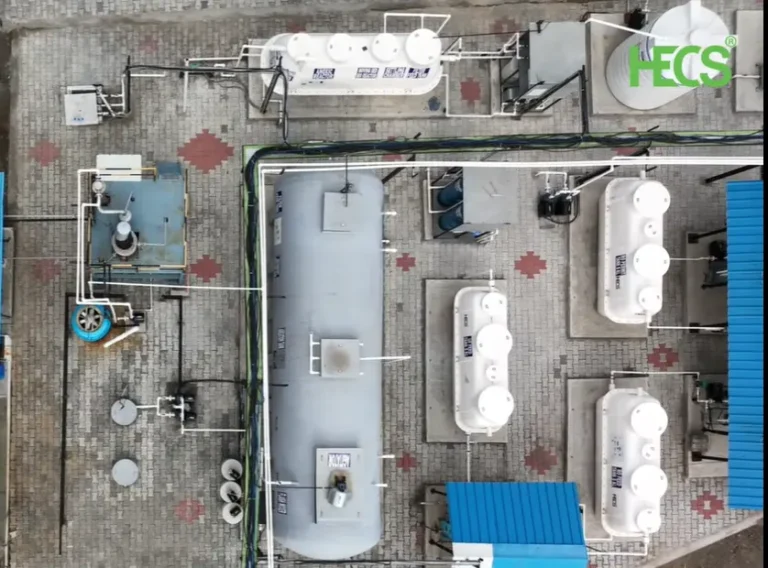
6 KLD STP + 20 KLD ETP, Global Pharma
Separate sewage and process-effluent treatment for an API manufacturing facility.
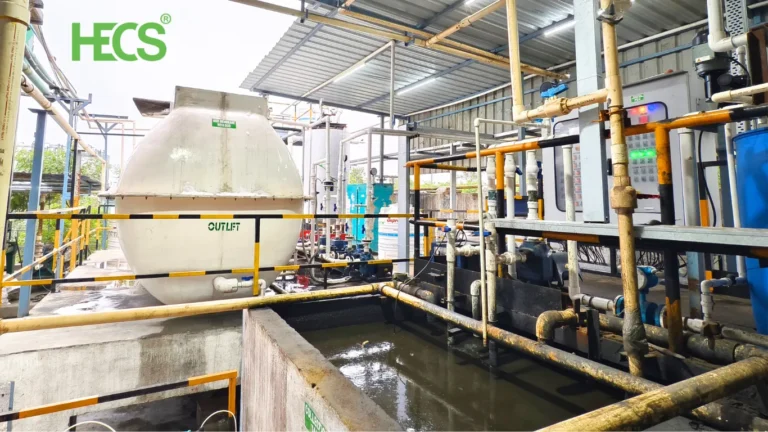
40 KLD packaged ETP, automobile ancillary
Process-effluent plant for an automobile component manufacturer; shown here as the ETP side of a factory.
Industrial packaged STP: frequently asked questions
What is an industrial packaged sewage treatment plant?
It is a factory-built plant that treats the domestic sewage generated at an industrial site, such as wastewater from toilets, washrooms, canteens and worker housing. It arrives pre-assembled and tested, needs minimal civil work and treats sewage biologically so it can be discharged within consent limits or reused.
Does a factory need an STP, an ETP or both?
Most factories need an STP for domestic sewage. If manufacturing creates wastewater (washing, plating, dyeing, chemical or pharma processes), that process effluent needs an ETP. Where both exist they are usually treated in separate plants. Your State Pollution Control Board consent states what is required.
Can a packaged STP treat industrial process effluent?
No. A sewage STP is designed for biodegradable domestic sewage. Oils, solvents, metals, high-TDS or toxic streams can upset its biology. Process effluent should go to an ETP designed after analysing it. HECS supplies both packaged STPs and customised packaged ETPs.
How do I calculate STP capacity for a factory?
Capacity is based on daily sewage flow: employees per shift and number of shifts, canteen meals, any residents in worker housing and actual water-use records, plus a margin for peaks and growth. Use the HECS sewage generation calculator for an estimate, then confirm it with an HECS engineer.
Which is better for industries, MBBR or MBR?
Both work for industrial sewage. MBBR (HECS Ultima) is robust and usually cheaper to run. MBR (HECS Amaze) gives clearer water in a smaller footprint and suits strict limits or high reuse, but needs membrane cleaning and usually costs more. HECS recommends one after checking your load, space and consent limits.
What treated-water quality do HECS plants achieve?
Design values for typical domestic sewage from the HECS brochure are BOD below 20 and TSS below 50 mg/l for Ultima, BOD below 10 and TSS below 20 mg/l for Ultima+, and BOD below 5, COD below 30 and TSS below 5 mg/l for Amaze. Actual results depend on inlet quality and operation.
Can treated sewage be reused in a factory?
Yes, commonly for toilet flushing, gardening, landscaping and floor washing. Cooling tower make-up is possible but usually needs extra treatment. Any reuse must meet the standards and conditions in your State Pollution Control Board consent.
Which approvals does an industrial STP need?
Industrial units generally need Consent to Establish and Consent to Operate from their State Pollution Control Board. The consent sets the outlet limits for sewage and effluent. Requirements vary by state and industry, so check your consent or ask HECS to review it during design.
How long does it take to install an industrial packaged STP?
The plant is built and tested in the HECS factory while site preparation runs in parallel, so on-site work is much shorter than for a concrete STP. The overall schedule depends on capacity, civil work and approvals and is confirmed in the technical proposal.
What does an industrial STP AMC include?
HECS annual maintenance contracts cover routine operation checks, preventive maintenance of blowers and pumps, sludge removal scheduling, spares and breakdown support. SmartHub alerts and reports are included on connected plants. The exact scope is agreed per site.
Can HECS upgrade an existing industrial STP?
Yes. HECS upgraded Interarch Building Products’ manually operated conventional STP to a 30 KLD Ultima+ Smart STP with automated operation and remote monitoring. Share your existing plant’s capacity, process and problems for an upgrade assessment.
Does HECS supply industrial STPs outside India?
HECS supplies packaged sewage treatment plants for projects in India, the GCC, Sri Lanka and other countries. Share your country, site details and local discharge limits through the enquiry form or WhatsApp.
Request a technical consultation
Share your project and an HECS engineer will reply within minutes with the questions needed to size your STP, or a technical proposal if you already have the data. Helpful to include:
- Company, project location and industry
- Employees per shift and number of shifts
- Canteen and worker housing on site (yes/no)
- Need: new STP, upgrade, O&M or AMC
- Reuse plans and consent limits, if known
Prefer to talk?
Hubert Enviro Care Systems, A21, 3rd Phase, TVK Industrial Estate, Guindy, Chennai 600032. Your details are used only to respond to this enquiry.
Related HECS solutions and guides
- Packaged sewage treatment plant: types, sizes and cost factors
- HECS Ultima MBBR packaged STP
- HECS Amaze MBR packaged STP
- Customised packaged effluent treatment plants
- HECS SmartHub IoT monitoring
- Industrial STP design: components and process
- Sewage generation calculator
- Completed STP and ETP projects