
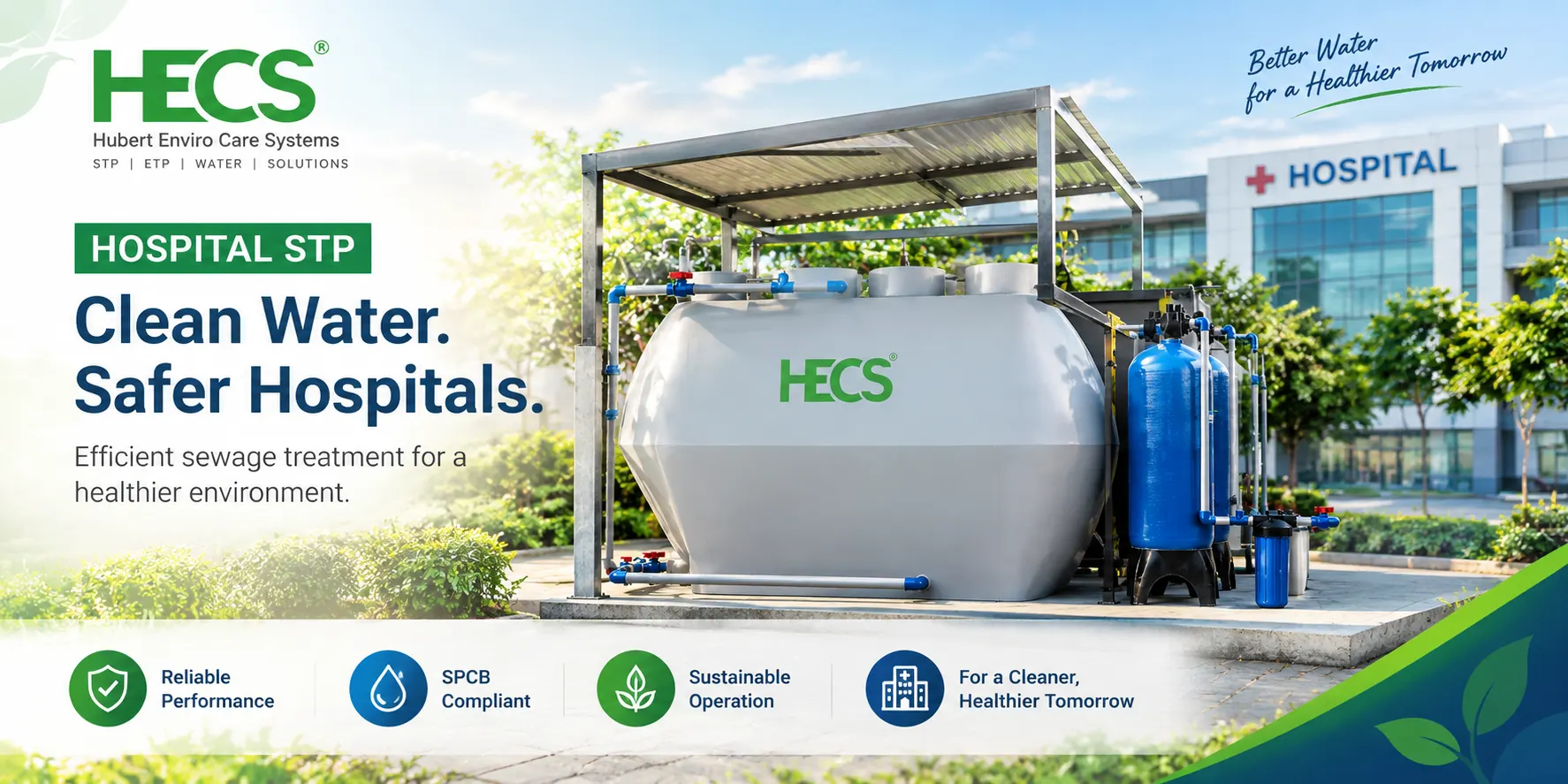
Hospital STP & Healthcare Wastewater Treatment in India

A hospital STP (sewage treatment plant) is an on-site plant that treats sewage from wards, toilets, OPDs, kitchens and staff areas to meet your State Pollution Control Board (SPCB) consent limits for reuse or discharge. Lab, OT and laundry wastewater usually needs separate pre-treatment or an effluent treatment plant (ETP) first.
For hospital owners, administrators, facility heads and MEP consultants.
Quick answer
• Size: about 30 KLD (kilolitres per day) for a 100-bed hospital, before kitchen, laundry and OPD loads (NBC 2016 norms, ~80% returned as sewage).
• Technology: MBBR suits most hospitals; MBR suits tight sites and high-grade reuse.
• Compliance: SPCB consent (CTE/CTO), BMW Rules 2016 authorisation and pre-treatment of chemical liquid waste.
• Cost: mainly capacity (KLD) and technology; HECS hospital ETPs run from about ₹5 lakh to over ₹2 crore.
What Is a Hospital or Healthcare STP?
A Sewage Treatment Plant (STP) for healthcare facilities is an engineered system designed primarily to treat domestic sewage generated by hospitals, clinics, diagnostic centres, medical colleges, and healthcare campuses.
Typical wastewater sources include:
- Patient wards and rooms
- Toilets and bathrooms
- OPD areas
- Kitchens and cafeterias
- Laundry facilities
- Staff facilities and general campus sewage
The treatment process removes organic matter, suspended solids, nutrients, and microorganisms so treated water can be reused or discharged in line with applicable consent conditions.
Not all wastewater inside a hospital is identical, however. Laboratory wastewater, chemical wastewater, or other specialised streams may need separate management or additional treatment depending on their characteristics. The system must therefore be designed around the facility’s actual wastewater sources, flow profile, pollutant characteristics, treatment objectives, available space, and regulatory requirements.
Hospital STP vs ETP: which does your hospital need?
Most hospitals need both: an STP for domestic sewage, and an ETP or pre-treatment unit for clinical and chemical wastewater. Segregation protects the STP: disinfectant and lab-chemical shock loads can kill the bacteria it depends on.
Wastewater stream | Typical sources | Treated in |
Domestic sewage | Ward and staff toilets, OPD, staff quarters | STP |
Kitchen wastewater | Main kitchen, canteen, cafeteria | Grease trap, then STP |
Clinical and chemical effluent | Labs, OT washings, blood bank, autoclave, discarded disinfectants | ETP or pre-treatment |
Laundry effluent | Linen washing with detergents and disinfectants | ETP or pre-treatment |
HECS MediClear is our packaged hospital ETP for these clinical and laundry streams.
How to calculate STP capacity for a hospital
Multiply beds by the NBC 2016 water norm, take about 80% as sewage (the CPHEEO default), then add other loads. NBC 2016 sets 340 litres per bed per day for hospitals up to 100 beds and 450 for larger hospitals, excluding laundry and kitchen.
Hospital size | Water demand | Sewage (~80%) | STP size, bed load only |
50 beds | 17 KLD | 13.6 KLD | 15 KLD |
100 beds | 34 KLD | 27.2 KLD | 30 KLD |
200 beds | 90 KLD | 72 KLD | 80 KLD |
300 beds | 135 KLD | 108 KLD | 120 KLD |
500 beds | 225 KLD | 180 KLD | 200 KLD |
Sizes include about 10% headroom. Add OPD at 15 litres per visitor (a 400-visit OPD adds about 5 KLD of sewage), staff quarters at 135 litres per head, and measured kitchen and laundry use.
Need your exact number? Try the HECS sewage calculator or send us your bed count and OPD footfall.
MBBR vs SBR vs MBR: which STP technology is best for hospitals?
MBBR (moving bed biofilm reactor) suits most hospitals: it rides out load swings and is simple to run. MBR (membrane bioreactor) suits basements, tight sites and high-grade reuse; SBR (sequencing batch reactor) suits large campuses with skilled operators.
Technology | Best for | Strength | Watch-out |
MBBR | Most hospitals | Tolerates variable loads; simple operation | Needs a clarifier, plus filters for reuse |
SBR | Large campuses | Treats and settles in one tank | Depends on PLC cycles and skilled operators |
MBR | Tight sites, reuse | Best water quality; smallest footprint | Higher capex and power; membrane cleaning |
Always add an equalisation tank for morning peaks and disinfection (UV, chlorination or ozone): hospital wastewater can carry pathogens and antibiotic-resistant bacteria. Need reuse-grade water in less space? See HECS Amaze MBR.
How much does a hospital STP cost in India?
Hospital STP cost depends mainly on capacity (KLD) and specification. For reference, HECS hospital ETPs run from about ₹5 lakh to over ₹2 crore. Four more factors drive lifetime cost:
• Technology: MBR costs more upfront than MBBR but saves space and delivers reuse-grade water.
• Reuse quality: tertiary filters and UV or ozone add cost but cut freshwater bills.
• Site and automation: basement installation, excavation, PLC controls and IoT monitoring.
• Running cost: power, chemicals, operator, testing and sludge disposal. Compare lifecycle cost, not purchase price.
Get a budget quote for your capacity.
What rules apply to hospital wastewater in India?
Three main requirements govern hospital wastewater:
• CTE and CTO: under the Water (Prevention and Control of Pollution) Act, 1974, you need your SPCB’s Consent to Establish before construction and Consent to Operate before operations start (TNPCB in Tamil Nadu).
• Bio-Medical Waste (BMW) Management Rules 2016: chemical liquid waste (lab liquids, discarded disinfectants and formalin, X-ray developer, aspirated body fluids, floor washings) must be collected separately and pre-treated before mixing with other wastewater.
• Discharge limits: hospitals not connected to a public sewer with a terminal STP must meet these BMW Rules limits:
Parameter | BMW Rules 2016 limit |
pH | 6.5–9.0 |
Suspended solids | 100 mg/L |
Oil and grease | 10 mg/L |
BOD | 30 mg/L |
COD | 250 mg/L |
Bio-assay | 90% fish survival after 96 hours in 100% effluent |
Consent orders may set tighter limits, especially for reuse; see our state-wise STP regulations.
Why hospital STPs fail, and how to prevent it
Most hospital STP failures trace back to wrong sizing, chemical shock loads, missing equalisation, and irregular operation and sludge removal. The fixes: a measured flow study, a separate ETP, a sized equalisation tank, and a trained operator or annual maintenance contract (AMC). HECS SmartHub adds live IoT monitoring, fault alerts and compliance-ready reports for HECS plants.
FAQs
Is an STP mandatory for hospitals in India?
Usually, yes. Hospitals need SPCB consent to discharge wastewater, and those not connected to a public sewer with a terminal STP must treat liquid waste on-site to BMW Rules 2016 limits.
What size STP does a 100-bed hospital need?
About 30 KLD for the bed load (100 × 340 litres × 80%, plus headroom), or about 35 KLD with a 400-visit OPD, before kitchen and laundry. Confirm it with a flow study.
Can treated hospital STP water be reused?
Yes, for toilet flushing, landscaping and cooling towers, if it meets your consent’s reuse limits. That usually needs MBR or tertiary filtration plus disinfection.
Can a hospital STP be installed in a basement?
Yes. Packaged STPs can sit above or below ground; plan ventilation, odour control and service access.
Plan your hospital STP with HECS
Hubert Enviro Care Systems (HECS) manufactures packaged STPs and hospital ETPs at its Sriperumbudur factory near Chennai, then installs, commissions and maintains them across India.
Planning a new hospital, adding beds or renewing consent? Send your bed count, OPD footfall, location and available space for a capacity recommendation and free quote
Build a Greener Future – Connect with HECS Now!
Looking for reliable wastewater treatment solutions? Get expert guidance and find the perfect STP for your needs today!
Frequently Asked Questions
1.What is the purpose of a sewage treatment plant in Saudi Arabia?
A sewage treatment plant in Saudi Arabia is designed to remove contaminants from wastewater, making it safe for reuse or environmental discharge. It supports Saudi Vision 2030’s goals of water conservation and sustainable resource management.
2. How does a sewage treatment plant work in Saudi Arabia?
Modern STPs in Saudi Arabia use biological and mechanical processes such as MBBR, SBR, or MBR technology to treat sewage. These systems ensure that wastewater is purified efficiently for reuse in landscaping, industries, and non-potable applications.
3. Why is wastewater treatment important for Saudi Vision 2030?
Wastewater treatment is a crucial component of Vision 2030, as it reduces freshwater dependency and fosters sustainable development. By reusing treated water, Saudi Arabia can achieve its long-term goals for water security and environmental sustainability.
4. What is the best wastewater treatment technology for Saudi Arabia's climate?
Given high temperatures, extended aeration systems, MBBR, and membrane bioreactors (MBR) perform well. These handle temperature variations, require less space, and produce high-quality effluent suitable for reuse in arid climates where water conservation is critical.
5. What permits are required for wastewater treatment plants in Saudi Arabia?
Required permits include environmental impact assessment approval, construction permit from municipality, operational license from Ministry of Water and Electricity, discharge permit, health department approval for reuse applications, and civil defense safety clearance.
6. Can treated wastewater be reused in Saudi Arabia?
Yes, treated wastewater can be reused for irrigation, cooling towers, toilet flushing, and industrial processes. This reduces pressure on freshwater sources and supports sustainable water management.
7. Who are the leading sewage treatment plant suppliers in Saudi Arabia?
HECS (Hubert Enviro Care Systems) is among the leading STP suppliers in Saudi Arabia, offering AI-powered, energy-efficient, and low-maintenance wastewater treatment systems across industries and municipalities.
8. How to choose the right sewage treatment plant for your project in Saudi Arabia?
Evaluate factors like water flow capacity, site space, effluent standards, and reuse purpose. Consulting experts like HECS ensures the STP is efficient, cost-effective, and compliant with Saudi Vision 2030 standards.
9. How often should wastewater treatment equipment be maintained?
Common chemicals include chlorine/hypochlorite (disinfection), coagulants like aluminum sulfate or ferric chloride (solids removal), pH adjusters (lime, acids), polymers (flocculation), and nutrients (phosphorus/nitrogen) for biological processes. Usage varies by system type.
10. What chemicals are used in wastewater treatment?
Establishing compliant resource recovery partnerships requires comprehensive documentation, ensuring regulatory adherence:
Recycler Authorization Verification:
- Valid authorization certificates from State Pollution Control Boards
- Specific waste category handling permissions
- Environmental clearance certificates
- Financial assurance and insurance documentation
Partnership Agreement Documentation:
- Waste acceptance criteria and quality specifications
- Transportation and handling responsibility matrix
- Compliance monitoring and reporting protocols
- Liability distribution and environmental insurance clauses
Operational Compliance Records:
- Monthly sludge generation and dispatch registers
- Quality analysis reports from NABL-approved laboratories
- Transportation manifests and delivery receipts
- End-product certification and quality compliance
Regulatory Reporting Requirements:
- Quarterly compliance reports to State Pollution Control Boards
- Annual environmental audit reports
- Resource recovery efficiency and environmental benefit documentation
- Waste minimization achievement records
Quality Assurance Protocol:
- Regular recycler facility audits and performance assessments
- End-product quality verification and market compliance
- Environmental monitoring at recycler facilities
- Customer feedback and market acceptance documentation
Risk Management Documentation:
- Environmental liability insurance policies
- Contingency plans for partnership disruption
- Alternative disposal arrangements and cost provisions
- Legal compliance verification and update protocols
Financial Documentation:
- Cost-benefit analysis and savings documentation
- Payment terms and financial performance tracking
- Comparative disposal cost analysis
- Return on investment calculations for resource recovery initiatives