
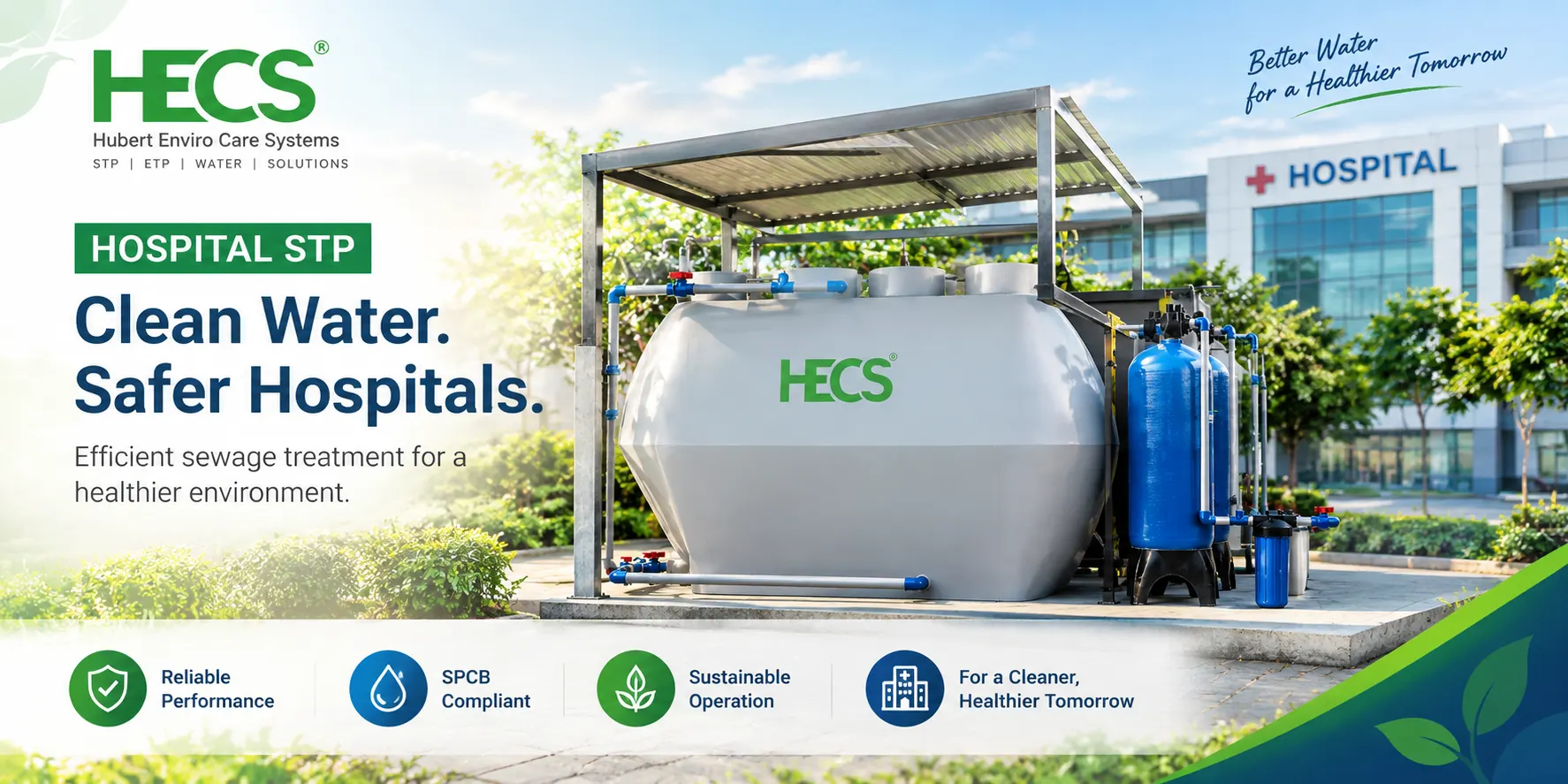
Hospital STP & Healthcare Wastewater Treatment in India
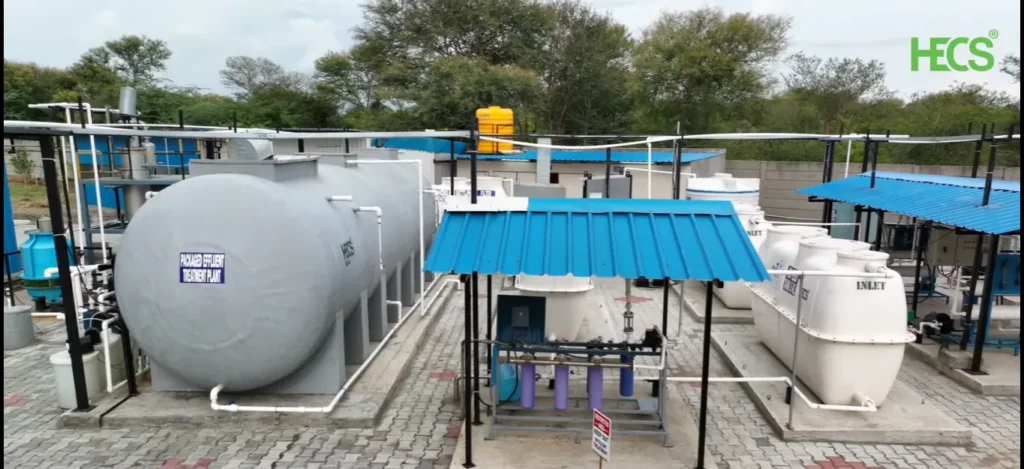
A hospital STP (sewage treatment plant) is an on-site plant that treats sewage from wards, toilets, OPDs, kitchens and staff areas to meet your State Pollution Control Board (SPCB) consent limits for reuse or discharge. Lab, OT and laundry wastewater usually needs separate pre-treatment or an effluent treatment plant (ETP) first.
For hospital owners, administrators, facility heads and MEP consultants.
Quick answer
• Size: about 30 KLD (kilolitres per day) for a 100-bed hospital, before kitchen, laundry and OPD loads (NBC 2016 norms, ~80% returned as sewage).
• Technology: MBBR suits most hospitals; MBR suits tight sites and high-grade reuse.
• Compliance: SPCB consent (CTE/CTO), BMW Rules 2016 authorisation and pre-treatment of chemical liquid waste.
• Cost: mainly capacity (KLD) and technology; HECS hospital ETPs run from about ₹5 lakh to over ₹2 crore.
What Is a Hospital or Healthcare STP?
A Sewage Treatment Plant (STP) for healthcare facilities is an engineered system designed primarily to treat domestic sewage generated by hospitals, clinics, diagnostic centres, medical colleges, and healthcare campuses.
Typical wastewater sources include:
- Patient wards and rooms
- Toilets and bathrooms
- OPD areas
- Kitchens and cafeterias
- Laundry facilities
- Staff facilities and general campus sewage
The treatment process removes organic matter, suspended solids, nutrients, and microorganisms so treated water can be reused or discharged in line with applicable consent conditions.
Not all wastewater inside a hospital is identical, however. Laboratory wastewater, chemical wastewater, or other specialised streams may need separate management or additional treatment depending on their characteristics. The system must therefore be designed around the facility’s actual wastewater sources, flow profile, pollutant characteristics, treatment objectives, available space, and regulatory requirements.
Hospital STP vs ETP: which does your hospital need?
Most hospitals need both: an STP for domestic sewage, and an ETP or pre-treatment unit for clinical and chemical wastewater. Segregation protects the STP: disinfectant and lab-chemical shock loads can kill the bacteria it depends on.
Wastewater stream | Typical sources | Treated in |
Domestic sewage | Ward and staff toilets, OPD, staff quarters | STP |
Kitchen wastewater | Main kitchen, canteen, cafeteria | Grease trap, then STP |
Clinical and chemical effluent | Labs, OT washings, blood bank, autoclave, discarded disinfectants | ETP or pre-treatment |
Laundry effluent | Linen washing with detergents and disinfectants | ETP or pre-treatment |
HECS MediClear is our packaged hospital ETP for these clinical and laundry streams.
How to calculate STP capacity for a hospital
Multiply beds by the NBC 2016 water norm, take about 80% as sewage (the CPHEEO default), then add other loads. NBC 2016 sets 340 litres per bed per day for hospitals up to 100 beds and 450 for larger hospitals, excluding laundry and kitchen.
Hospital size | Water demand | Sewage (~80%) | STP size, bed load only |
50 beds | 17 KLD | 13.6 KLD | 15 KLD |
100 beds | 34 KLD | 27.2 KLD | 30 KLD |
200 beds | 90 KLD | 72 KLD | 80 KLD |
300 beds | 135 KLD | 108 KLD | 120 KLD |
500 beds | 225 KLD | 180 KLD | 200 KLD |
Sizes include about 10% headroom. Add OPD at 15 litres per visitor (a 400-visit OPD adds about 5 KLD of sewage), staff quarters at 135 litres per head, and measured kitchen and laundry use.
Need your exact number? Try the HECS sewage calculator or send us your bed count and OPD footfall.
MBBR vs SBR vs MBR: which STP technology is best for hospitals?
MBBR (moving bed biofilm reactor) suits most hospitals: it rides out load swings and is simple to run. MBR (membrane bioreactor) suits basements, tight sites and high-grade reuse; SBR (sequencing batch reactor) suits large campuses with skilled operators.
Technology | Best for | Strength | Watch-out |
MBBR | Most hospitals | Tolerates variable loads; simple operation | Needs a clarifier, plus filters for reuse |
SBR | Large campuses | Treats and settles in one tank | Depends on PLC cycles and skilled operators |
MBR | Tight sites, reuse | Best water quality; smallest footprint | Higher capex and power; membrane cleaning |
Always add an equalisation tank for morning peaks and disinfection (UV, chlorination or ozone): hospital wastewater can carry pathogens and antibiotic-resistant bacteria. Need reuse-grade water in less space? See HECS Amaze MBR.
How much does a hospital STP cost in India?
Hospital STP cost depends mainly on capacity (KLD) and specification. For reference, HECS hospital ETPs run from about ₹5 lakh to over ₹2 crore. Four more factors drive lifetime cost:
• Technology: MBR costs more upfront than MBBR but saves space and delivers reuse-grade water.
• Reuse quality: tertiary filters and UV or ozone add cost but cut freshwater bills.
• Site and automation: basement installation, excavation, PLC controls and IoT monitoring.
• Running cost: power, chemicals, operator, testing and sludge disposal. Compare lifecycle cost, not purchase price.
Get a budget quote for your capacity.
What rules apply to hospital wastewater in India?
Three main requirements govern hospital wastewater:
• CTE and CTO: under the Water (Prevention and Control of Pollution) Act, 1974, you need your SPCB’s Consent to Establish before construction and Consent to Operate before operations start (TNPCB in Tamil Nadu).
• Bio-Medical Waste (BMW) Management Rules 2016: chemical liquid waste (lab liquids, discarded disinfectants and formalin, X-ray developer, aspirated body fluids, floor washings) must be collected separately and pre-treated before mixing with other wastewater.
• Discharge limits: hospitals not connected to a public sewer with a terminal STP must meet these BMW Rules limits:
Parameter | BMW Rules 2016 limit |
pH | 6.5–9.0 |
Suspended solids | 100 mg/L |
Oil and grease | 10 mg/L |
BOD | 30 mg/L |
COD | 250 mg/L |
Bio-assay | 90% fish survival after 96 hours in 100% effluent |
Consent orders may set tighter limits, especially for reuse; see our state-wise STP regulations.
Why hospital STPs fail, and how to prevent it
Most hospital STP failures trace back to wrong sizing, chemical shock loads, missing equalisation, and irregular operation and sludge removal. The fixes: a measured flow study, a separate ETP, a sized equalisation tank, and a trained operator or annual maintenance contract (AMC). HECS SmartHub adds live IoT monitoring, fault alerts and compliance-ready reports for HECS plants.
FAQs
Is an STP mandatory for hospitals in India?
Usually, yes. Hospitals need SPCB consent to discharge wastewater, and those not connected to a public sewer with a terminal STP must treat liquid waste on-site to BMW Rules 2016 limits.
What size STP does a 100-bed hospital need?
About 30 KLD for the bed load (100 × 340 litres × 80%, plus headroom), or about 35 KLD with a 400-visit OPD, before kitchen and laundry. Confirm it with a flow study.
Can treated hospital STP water be reused?
Yes, for toilet flushing, landscaping and cooling towers, if it meets your consent’s reuse limits. That usually needs MBR or tertiary filtration plus disinfection.
Can a hospital STP be installed in a basement?
Yes. Packaged STPs can sit above or below ground; plan ventilation, odour control and service access.
Plan your hospital STP with HECS
Hubert Enviro Care Systems (HECS) manufactures packaged STPs and hospital ETPs at its Sriperumbudur factory near Chennai, then installs, commissions and maintains them across India.
Planning a new hospital, adding beds or renewing consent? Send your bed count, OPD footfall, location and available space for a capacity recommendation and free quote
Build a Greener Future – Connect with HECS Now!
Looking for reliable wastewater treatment solutions? Get expert guidance and find the perfect STP for your needs today!
Frequently Asked Questions
1.What is the recommended STP capacity for a 100-bed hospital in India?
A 100-bed hospital requires approximately 30 KLD (30,000 litres per day) of sewage treatment capacity as an initial planning estimate. This calculation uses 340 litres of water per bed per day and an assumed sewage return rate of 80%, producing about 27.2 KLD of sewage. The final STP capacity should account for OPD visitors, staff, kitchen and laundry wastewater, peak flows, and applicable consent conditions.
2. How much does a hospital STP cost in India in 2026?
Hospital STP costs depend on treatment capacity, technology, construction requirements, automation and treated-water quality. The budget should include equipment, installation, civil works, electrical systems, commissioning and ongoing maintenance. HECS publishes a hospital ETP reference range of approximately ₹5 lakh to over ₹2 crore; this is an ETP cost reference, not a universal hospital STP price. Request a project-specific quotation for an accurate estimate.
3. Does a hospital need both an STP and an ETP?
Most hospitals should assess the need for both a Sewage Treatment Plant (STP) and an Effluent Treatment Plant (ETP). An STP treats domestic sewage from toilets, wards and staff facilities, while an ETP or suitable pre-treatment system manages relevant clinical, laboratory and chemical wastewater. Kitchen wastewater may require grease removal, and laundry wastewater must be assessed separately. The treatment arrangement depends on wastewater characteristics and regulatory requirements.
4. Which STP technology is best for hospitals: MBBR, SBR or MBR?
MBBR is a practical option for many hospitals, MBR suits space-constrained sites and higher-quality reuse requirements, and SBR can suit campuses with appropriate operational expertise. MBBR uses attached-growth biological treatment, SBR operates in timed treatment cycles, and MBR combines biological treatment with membrane separation. The best technology depends on influent quality, available space, discharge standards, reuse goals, operating costs and maintenance capability.
5. What are the wastewater discharge standards for hospitals in India?
Applicable standards depend on the wastewater stream, discharge destination, State Pollution Control Board (SPCB) consent conditions and relevant regulations. Under the Bio-Medical Waste Management Rules, 2016, the specified liquid-waste standards include pH 6.5–9.0, suspended solids 100 mg/L, oil and grease 10 mg/L, BOD 30 mg/L and COD 250 mg/L for the specified healthcare-facility discharge circumstances. Additional or stricter requirements may apply. Hospitals should verify the current applicable standards before designing their treatment systems
6. What approvals are required for a hospital STP in India?
Hospitals must assess applicable Consent to Establish (CTE), Consent to Operate (CTO), and Bio-Medical Waste Management authorisation requirements with their SPCB or Pollution Control Committee. Requirements depend on the facility, location, wastewater discharge arrangement and applicable rules. In Tamil Nadu, hospitals should consult the Tamil Nadu Pollution Control Board (TNPCB) for the relevant approvals and conditions.
7. Can treated hospital STP water be reused?
Yes. Properly treated hospital sewage may be reused for suitable non-potable applications, such as toilet flushing, landscaping and gardening, where permitted. The treatment process must achieve the required water quality for the intended use, including appropriate filtration and disinfection where necessary. Reuse arrangements must comply with local regulations and applicable consent conditions.
8. How is hospital STP capacity calculated based on beds and OPD visitors?
Hospital STP capacity is estimated by calculating daily water demand, applying an appropriate sewage return factor, and adding other wastewater loads. For example, a 100-bed hospital using 340 litres per bed per day generates an estimated 27.2 KLD of sewage at an 80% return rate, before additional loads. OPD visitors, staff quarters, kitchens, laundry and peak-flow conditions must also be evaluated. A detailed flow assessment helps determine the appropriate design capacity.
9. Why do hospital STPs fail, and how can maintenance prevent breakdowns?
Common causes include incorrect sizing, sudden chemical discharges, inadequate equalisation, poor aeration, excessive sludge accumulation and irregular maintenance. Hospitals can reduce these risks through wastewater segregation, routine monitoring, scheduled sludge removal, trained operators and preventive maintenance contracts. Online monitoring can also help identify abnormal operating conditions before they cause major treatment problems.
10. Which company provides hospital STP and ETP solutions in India?
Hubert Enviro Care Systems (HECS) provides packaged sewage treatment plants, hospital effluent treatment solutions, installation, commissioning and maintenance services. Its HECS MediClear solution is designed for hospital effluent treatment requirements, while its packaged STP solutions address sewage treatment applications. The appropriate system should be selected based on hospital capacity, wastewater characteristics, available space and applicable compliance requirements.