
In short: A textile unit usually needs two treatment plants: an ETP for dyeing, bleaching and washing effluent (colour, high TDS and COD), and an STP for sewage from workers, canteens and hostels. HECS designs packaged ETPs and factory-built packaged STPs, sized to your production and headcount, and installed with minimal civil work.
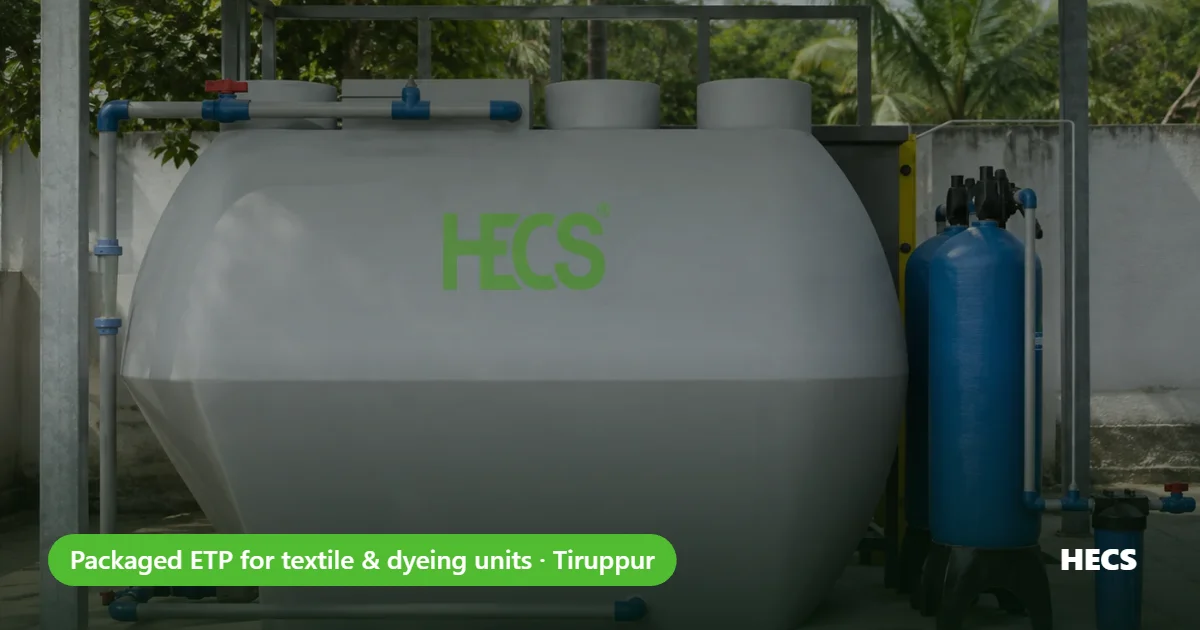
ETP for process effluent + STP for sewage
Typical water use per factory worker per day (with bathing)
HECS packaged STP range for workforce sewage
HECS in water and wastewater treatment
Which plant does your textile unit need?
The answer depends on what your unit does and where its effluent goes. Use this table as a first check, then share your data with us for a design.
| Unit type | Main wastewater | What you need | Notes |
|---|---|---|---|
| Dyeing, bleaching, printing, processing | Coloured effluent, high TDS, salts, high COD, variable pH | ETP (own or CETP-connected) + STP for workers | Tamil Nadu dyeing units operate under a zero liquid discharge (ZLD) regime; check your consent |
| Knitting and garment making | Mainly domestic sewage; some washing water | Packaged STP; small ETP only if washing or printing is done | Sewage grows with headcount and shifts |
| Spinning and weaving mills | Domestic sewage; humidification and cooling blowdown | Packaged STP for workers and hostels | Hostel blocks raise sewage per person sharply |
| Denim and garment washing | Indigo, enzymes, pumice, high COD | ETP with colour removal + STP | Reuse of treated water cuts fresh-water cost |
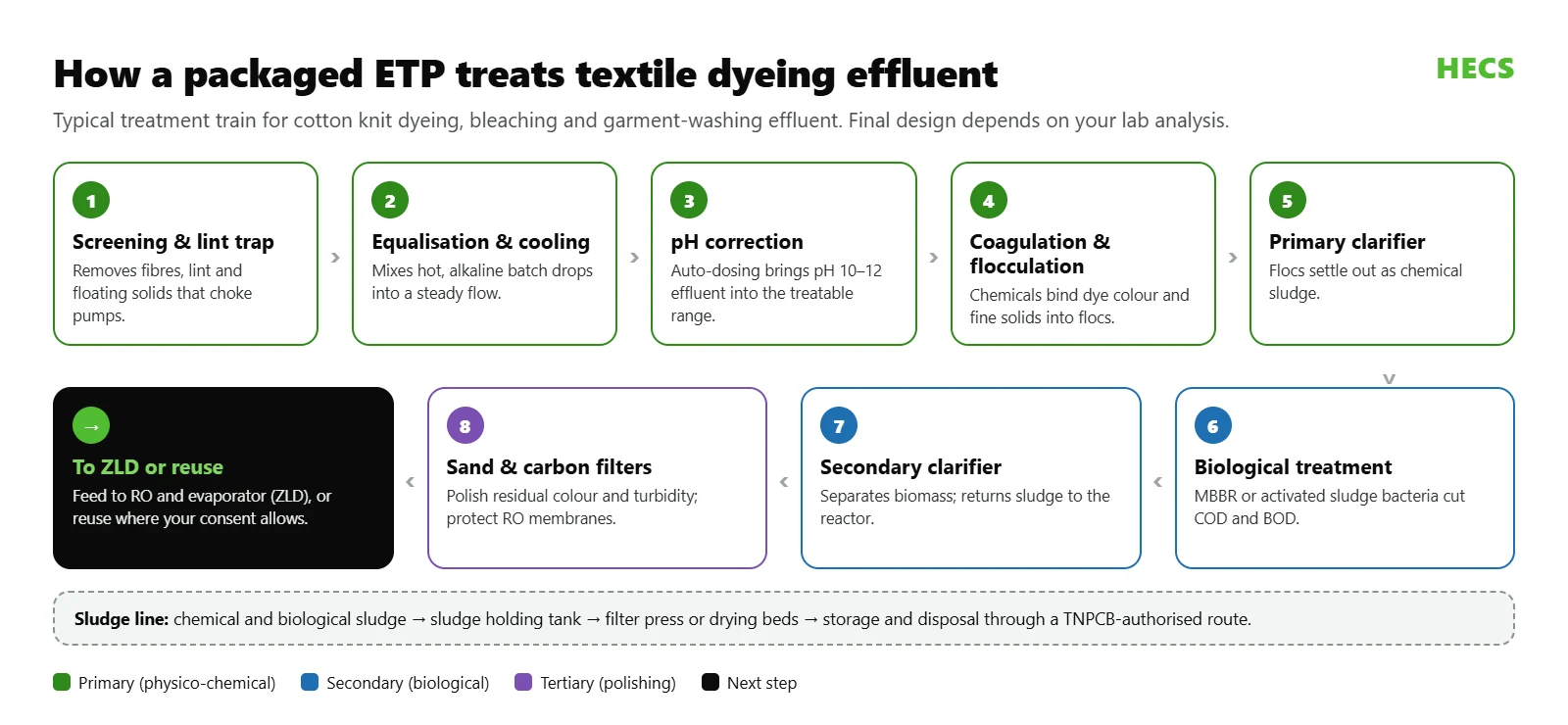
How textile effluent is treated
A typical textile ETP has five stages. The exact design depends on your dyes, chemicals and the discharge standard in your consent.
STP for your workers: the plant most textile units forget
Garment and spinning units can employ hundreds or thousands of people, and many run hostels. That sewage needs its own treatment plant. A packaged STP from HECS is built in our factory, delivered ready to install, and sized to your headcount.

How to size an STP for a textile unit
Sewage is roughly 80% of the water used. Planning figures for India (CPHEEO and the National Building Code) are about 45 litres per worker per day where bathing is provided, 30 litres where it is not, and about 135 litres per hostel resident.
| Workforce | Hostel residents | Approx. sewage | Typical packaged STP |
|---|---|---|---|
| 300 workers | none | 11 KLD | 10–15 KLD |
| 1,000 workers | none | 36 KLD | 40–50 KLD |
| 1,000 workers | 300 | 68 KLD | 75 KLD |
| 3,000 workers | 1,000 | 216 KLD | 200–250 KLD |
These are planning estimates only. We confirm the size from your water meter readings, shifts and canteen load. Try our sewage calculator or see the 50 KLD and 100 KLD packaged STPs.
CETP, own ETP or ZLD?
Many textile clusters run a Common Effluent Treatment Plant (CETP). Units connected to a CETP still pre-treat effluent to the CETP inlet standard, and still treat their own sewage. Units outside a CETP need their own ETP meeting the standard in their consent to operate.
Textile clusters we serve
HECS supplies packaged STPs and ETPs across India from our factory at SIPCOT Vallam Vadagal, Sriperumbudur, Chennai.
For Tamil Nadu consent and discharge rules, see the TNPCB STP guidelines and packaged STP in Tamil Nadu.
What drives the cost of a textile ETP and STP
See typical ranges in our ETP cost guide and STP cost guide.
Get an ETP and STP sized for your textile unit
Tell us about your unit and an HECS engineer will recommend the treatment route and plant size. Helpful to include:
- Process: dyeing, printing, washing, garment or spinning
- Daily water use or effluent flow (KLD)
- Number of workers and hostel residents
- Effluent test report, if you have one
- Location and CETP connection, if any
Quick estimate: 1,000 workers with bathing ≈ 40–50 KLD STP. Process effluent is sized from your production and water meter.
Prefer to talk?
Hubert Enviro Care Systems, A21, 3rd Phase, TVK Industrial Estate, Guindy, Chennai 600032. Your details are used only to respond to this enquiry.
Textile wastewater treatment: common questions
Can’t find your answer? Ask an HECS engineer. We reply within minutes.
Does a textile unit need both an ETP and an STP?
Usually yes. Process effluent from dyeing, washing or printing goes to an ETP (or a CETP after pre-treatment). Sewage from toilets, canteens and hostels goes to an STP. Mixing them makes both harder to treat.
What size STP does a garment factory need?
Roughly 45 litres of water per worker per day where bathing is provided, and sewage is about 80% of that. A 1,000-worker factory usually needs a 40–50 KLD packaged STP. Hostels add about 135 litres per resident.
Is ZLD mandatory for textile units?
It depends on the state, the cluster and your consent. Dyeing and bleaching units in Tiruppur have been required to achieve zero liquid discharge since 2011. Check the conditions in your consent to operate.
What is a CETP?
A Common Effluent Treatment Plant treats effluent from many small units in an industrial cluster. Member units pre-treat their effluent to the CETP inlet standard and pay treatment charges.
Can treated textile wastewater be reused?
Yes. With suitable tertiary treatment, treated water can be reused for gardening, toilet flushing, cooling or, with membranes, some process uses.
How long does it take to install a packaged STP?
A packaged STP is built in our factory, so site work is limited to the foundation, connections and commissioning. Timelines depend on capacity and site readiness.
Does HECS provide operation and maintenance?
Yes. HECS offers operation and maintenance support and SmartHub remote monitoring for its plants.
Running a dyeing, garment or spinning unit?
Tell us your process, flow and headcount. HECS will recommend the right ETP and STP and send a sized quote.