
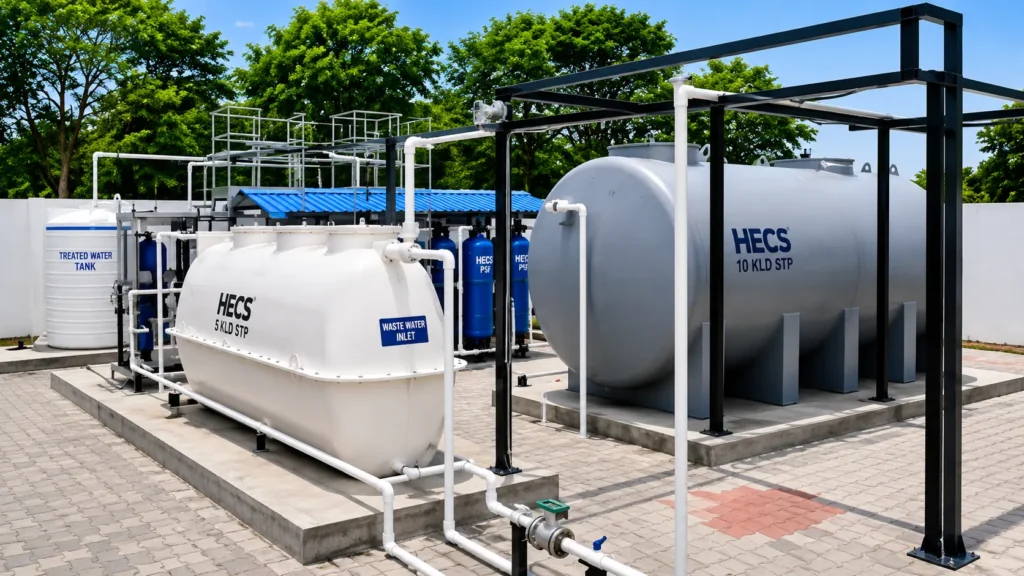
In short: HECS (Hubert Enviro Care Systems) is a packaged STP manufacturer based in Guindy, Chennai, with its factory at Sriperumbudur. Since 1997 we have worked in sewage treatment. We design, build, install and maintain factory-built FRP sewage treatment plants, MBBR (HECS Ultima) and MBR (HECS Amaze), from about 1 to 1,000 KLD for apartments, hospitals, hotels, schools, offices and factories across Tamil Nadu, designed to the outlet limits in your TNPCB consent.
In sewage treatment
Packaged STP range
To install a HECS Ultima unit
Typical reply to enquiries
HECS at a glance
| Company | Hubert Enviro Care Systems (HECS) |
| In sewage treatment since | 1997 |
| Head office | A21, 3rd Phase, TVK Industrial Estate, Guindy, Chennai 600032 |
| Factory | Sriperumbudur, near Chennai |
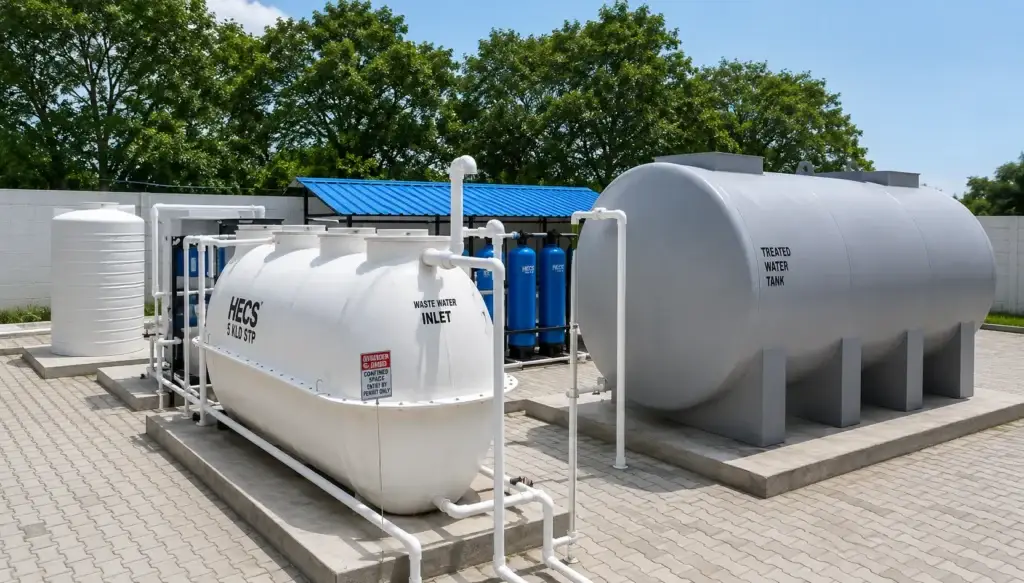
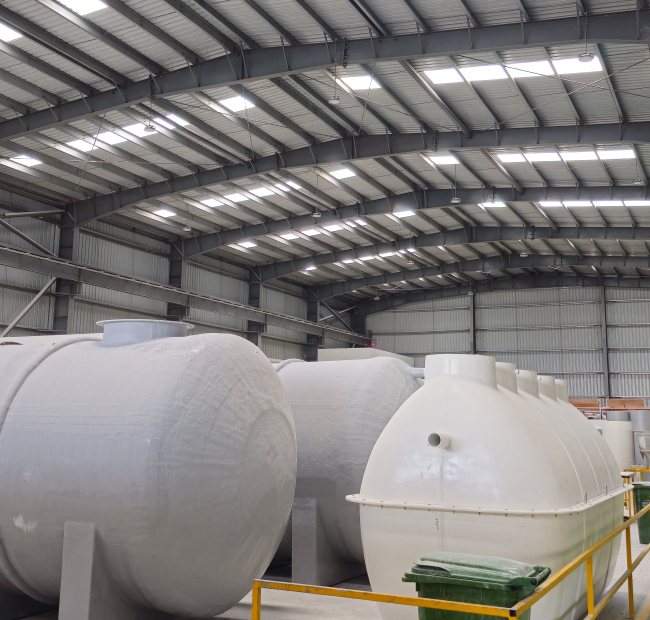
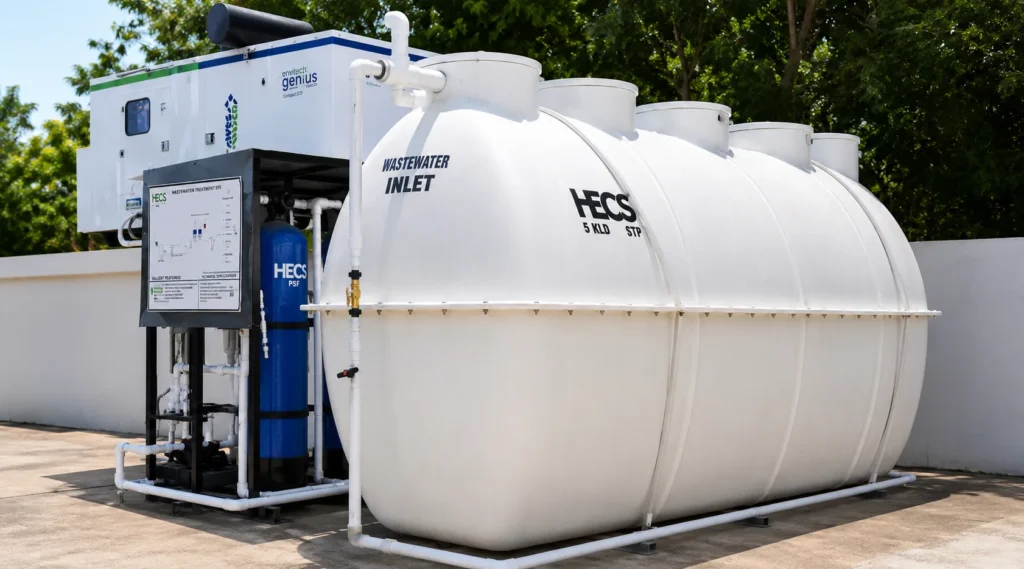
| Packaged STPs | HECS Ultima (MBBR) and HECS Amaze (MBR), factory-built FRP units |
| Capacity | About 1 to 1,000 KLD; larger sites with multiple units |
| Installation | Above or below ground |
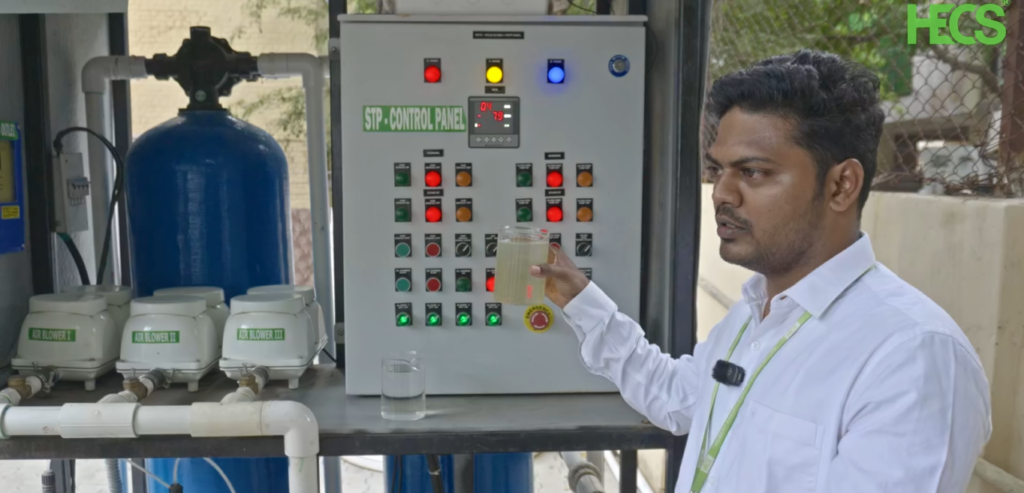
| Monitoring | HECS SmartHub IoT alerts and dashboards |
| After-sales | O&M and AMC contracts |
| Contact | +91 73580 51767 · WhatsApp +91 84388 64070 · [email protected] |
What is a packaged STP and how does it work?
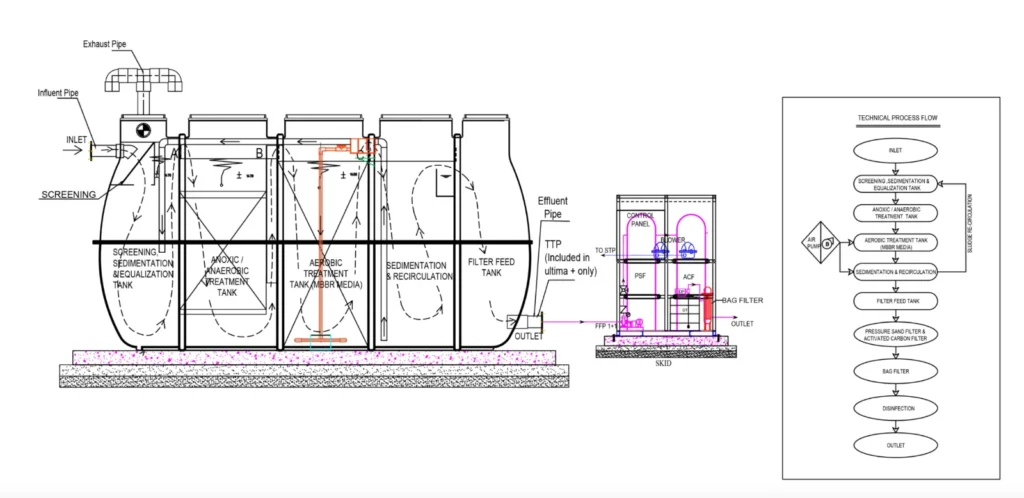
A packaged sewage treatment plant is a complete STP built and tested in a factory and delivered as one or more units, so site work is mainly the base or pit and connections. Sewage passes through these stages:
- Screening: removes rags, plastics and grit.
- Equalisation: evens out morning and evening peaks.
- Biological treatment: bacteria break down BOD and COD, on moving media (MBBR) or with membranes (MBR).
- Settling or membrane separation: separates clean water from sludge.
- Filtration and disinfection: polishes the water for discharge or reuse.
- Sludge handling: excess sludge is stored and removed.
Choose the technology
| HECS Ultima (MBBR) | HECS Amaze (MBR) | |
|---|---|---|
| Best for | Apartments, schools, offices, factory sewage | Flushing or cooling reuse, strict limits, tight space |
| Treated water | Meets typical discharge limits with filtration and disinfection | Designed for BOD and TSS below 5 mg/l |
| Running | Typically 1–2 hours of attention a week at small and mid sizes; below 50 dB | Membranes need regular cleaning and eventual replacement |
| Installation | Above or below ground; a unit installs in about two days | Above or below ground |
Product pages: HECS Ultima · HECS Amaze · HECS SmartHub. Compare in MBBR vs MBR vs SBR and FRP vs RCC STP.
STP plants for every type of site
Apartments and gated communities
Sized on flats and residents, with reuse for flushing and gardens.
Commercial buildings and IT parks
Compact plants for offices, malls and IT parks, with cooling-tower reuse.
Hotels and resorts
Low odour and noise, sized for guests and staff.
Hospitals
STP for sewage plus a separate ETP for lab, OT and laundry effluent.
Industries
Staff sewage from factories and campuses, kept apart from process effluent.
Schools and colleges
Sized on students, staff and hostels, with garden reuse.
Sector guides: apartments · commercial buildings · hotels · hospitals · industries · schools and colleges
How to size your STP
Daily sewage (KLD) = users × water use per person per day × 0.8 ÷ 1,000. The 0.8 is the share of water that returns as sewage (CPHEEO design basis). Water use figures from NBC 2016:
| Building | Water use | Example | Sewage | Starting plant size |
|---|---|---|---|---|
| Apartments | 135 litres per resident | 100 flats × 5 residents | 54 KLD | 60 KLD |
| Hotels | 180 litres per bed | 120 beds + 50 staff at 45 litres | about 19 KLD | 20–25 KLD |
| Hospitals over 100 beds | 450 litres per bed | 200 beds | 72 KLD | 75–80 KLD, plus an ETP |
| Offices and IT parks | 45 litres per person | 2,000 staff | 72 KLD | 75–80 KLD |
| Day schools and colleges | 45 litres per person | 1,500 students and staff | 54 KLD | 60 KLD |
More: STP capacity calculation · packaged STP guide · capacity calculator
TNPCB approvals and rules
MoEFCC’s environmental conditions for building bye-laws (9 December 2016) set the national baseline: buildings of 20,000 sq m and more must treat 100% of their wastewater on site and reuse it for landscaping, flushing and cooling towers, and buildings of 5,000 to 20,000 sq m need on-site treatment where no municipal sewer is available. The Tamil Nadu Pollution Control Board gives the Consent to Establish (before construction) and the Consent to Operate (before the plant runs) and sets the outlet limits. Share the HECS layout and plant specifications with your consultant for the applications.
Read: TNPCB STP guidelines · is an STP mandatory? · NGT outlet norms
HECS projects in Tamil Nadu
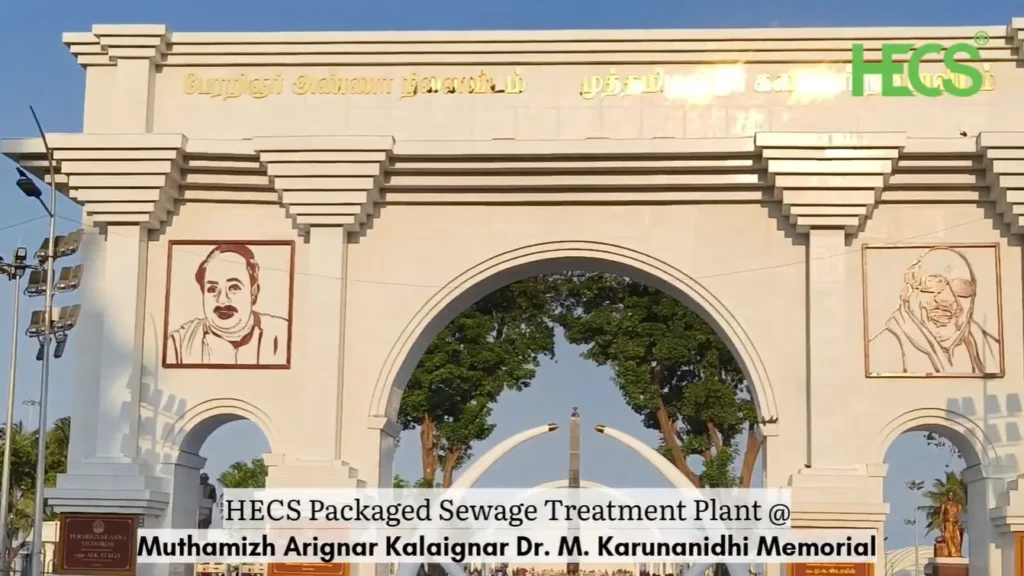
- 10 KLD packaged STP, Kalaignar Memorial, Chennai: design, supply, installation and commissioning, without disturbing daily visitors. Case study.
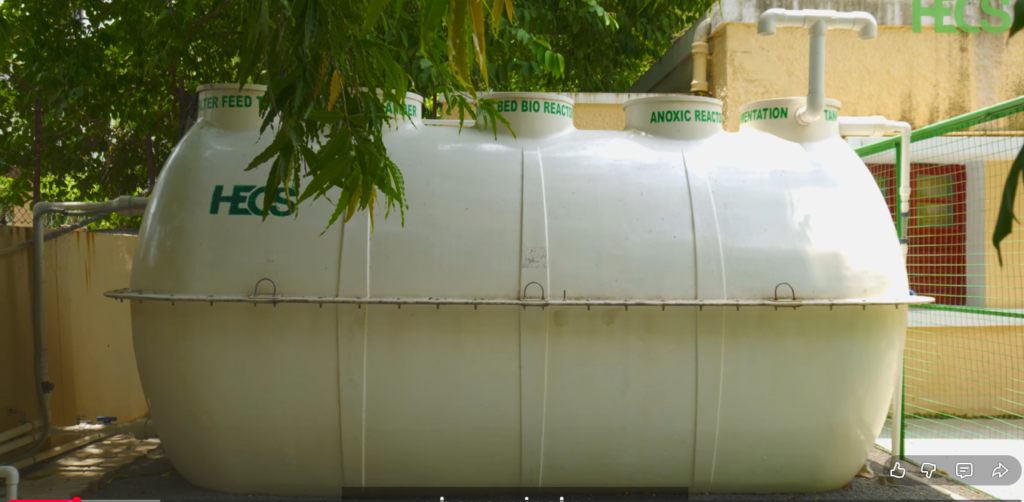
- 10 KLD MBBR STP, MCC School, Chennai: an above-ground FRP plant with a below-ground collection tank for a hostel of about 80 students; treated water is reused for gardening. Case study.
See all completed HECS projects.
What affects the cost of an STP in Tamil Nadu
- Capacity: daily and peak flow (KLD).
- Technology: MBBR or MBR, and the treated-water quality you need.
- Reuse: filtration and disinfection for flushing, gardens or cooling.
- Installation: above ground, or below ground with excavation.
- Automation: PLC controls and IoT monitoring.
- Site work: base or pit, pipelines, power supply and access.
- After-sales: O&M or AMC after commissioning.
There is no fixed price list; see STP plant cost in India for how quotes are built and compared.
From enquiry to a running plant
- Send your details: building type, users or flats, location, space, and reuse plans.
- Sizing and layout: an HECS engineer confirms capacity, technology and an above- or below-ground layout.
- Factory build: the FRP unit is built and tested at Sriperumbudur.
- Site preparation: base or pit, inlet and outlet levels, and power, by the HECS civil team or, if you prefer, your own contractor.
- Delivery and installation: placing, piping, blowers and control panel.
- Commissioning and handover: biological start-up and operator training.
- After handover: O&M or AMC with HECS SmartHub monitoring.
Guide: STP installation and commissioning.
After installation: O&M, AMC and SmartHub
Packaged plants still need daily checks of blowers, pumps and dosing, regular sludge removal and periodic cleaning. HECS offers O&M and AMC contracts, and HECS SmartHub sends alerts so a stopped blower or pump is caught early. If a plant has problems, see STP troubleshooting and why an STP smells.
Contact HECS in Chennai
Head office: A21, 3rd Phase, TVK Industrial Estate, Guindy, Chennai 600032, Tamil Nadu
Phone: +91 73580 51767
WhatsApp: +91 84388 64070
Email: [email protected]
Send your building type, users or KLD and location, and our team replies within minutes. Projects in Chennai: see also packaged STP in Chennai.
STP plant manufacturer in Tamil Nadu: FAQs
Can’t find your answer? Ask an HECS engineer. We reply within minutes.
Who is a reliable STP plant manufacturer in Tamil Nadu?
Choose a manufacturer that designs, builds, installs and maintains the plant, so one company answers for its performance, and ask to see plants of a similar size. HECS (Hubert Enviro Care Systems) has worked in sewage treatment since 1997, is based in Guindy, Chennai, and builds its FRP packaged STPs at its factory in Sriperumbudur. Use our 12-question buyer checklist.
Is an STP mandatory in Tamil Nadu?
For larger buildings, yes. Under MoEFCC’s December 2016 building conditions, buildings of 20,000 sq m or more must treat 100% of their sewage on site and reuse it, and buildings of 5,000 to 20,000 sq m need on-site treatment where there is no municipal sewer. Your building approval and TNPCB consent set the exact rules. See is an STP mandatory?.
What size STP do I need?
Daily sewage (KLD) = users × litres per person per day × 0.8 ÷ 1,000. A 100-flat block with 5 residents per flat at 135 litres a day makes about 54 KLD, so a 60 KLD plant is a sensible start. Use our capacity calculator.
Which STP technology is best?
MBBR (HECS Ultima) suits most apartments, schools, offices and factory sewage. MBR (HECS Amaze) suits sites that reuse water for flushing or cooling, have strict outlet limits or very little space. See MBBR vs MBR vs SBR.
How long does installation take?
A HECS Ultima unit is installed in about two days once the base or pit is ready, because it arrives factory-built and tested. Design approval, fabrication and commissioning add to this; from order to commissioning typically takes 4–6 weeks.
What TNPCB approvals are needed?
Usually a Consent to Establish before construction and a Consent to Operate before the plant runs. The CTO application usually needs treated-water test results from a recognised laboratory, which the owner arranges. See our TNPCB STP guidelines.
Can the STP be installed below ground?
Yes. HECS packaged STPs install above or below ground. Below-ground units sit in a pit with a base and anchoring designed for the groundwater level, with access covers and the control panel above ground.
Can treated water be reused?
Yes, for toilet flushing, landscaping and cooling towers, after filtration and disinfection. At MCC School, Chennai, treated water from the 10 KLD HECS STP is reused for gardening. See treated sewage water reuse.
Does HECS provide O&M and AMC in Tamil Nadu?
Yes. HECS is based in Chennai and offers O&M and AMC contracts, with HECS SmartHub remote monitoring that sends alerts when something needs attention.
What does an STP plant cost in Tamil Nadu?
The price depends on capacity, technology, reuse treatment, above- or below-ground installation and site work. See our STP plant cost guide, or send your details for a quotation.
Get your STP sized and quoted
Tell us the building type, users or flats, location and reuse plans. Our team replies within minutes.