
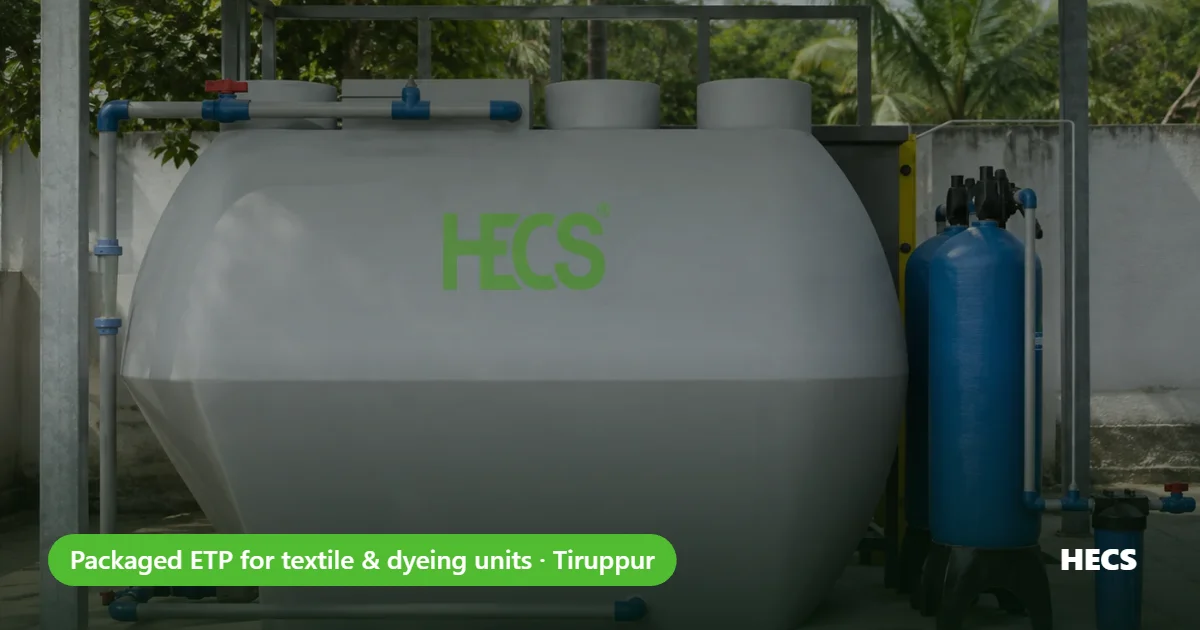
Textile ETP guide · Tiruppur, Tamil Nadu · Updated October 2026
An ETP (effluent treatment plant) for the textile industry removes colour, COD, BOD, suspended solids and extreme pH from dyeing, bleaching and washing wastewater so the water can be recycled.
In Tiruppur, textile dyeing and bleaching units operate on Zero Liquid Discharge (ZLD), so the ETP is the first half of a system that continues with reverse osmosis (RO) and evaporation. A packaged ETP is a factory-built, modular version that needs far less civil work, which suits small and mid-size dyeing units, garment-washing units, expanding units and sites with little land.
By the wastewater engineering team at Hubert Enviro Care Systems (HECS), Chennai · 10-minute read
- Tiruppur's dyeing and bleaching units run on Zero Liquid Discharge (ZLD); in January 2011 the Madras High Court closed 700+ units until they achieved it.
- Most units treat effluent through one of about 19 CETPs. A unit that is not on a CETP needs its own ETP with ZLD.
- An ETP removes colour, COD and solids, but not dissolved salts. TDS needs RO and an evaporator.
- Size the plant from production: cotton knit dyeing uses about 250–300 litres of water per kg of fabric.
- A packaged ETP is factory-built, fits small plots and grows module by module.
of India's knitwear exports come from Tiruppur
dyeing and bleaching units in the region
CETPs, each serving about 40–50 dyeing units
water recovery typical of ZLD systems
Source: Citizen consumer and civic Action Group (CAG), April 2026.
On this page
- Why Tiruppur units need ETP + ZLD
- CETP, own ETP or packaged ETP?
- What is in dyeing effluent
- How a textile ETP works
- From ETP to ZLD
- What size ETP you need
- Packaged vs civil ETP
- ETP plant cost factors
- TNPCB compliance checklist
- 50 KLD design example
- HECS packaged ETP options
- Do you also need an STP?
- FAQs
- Get a proposal
Why do Tiruppur textile units need an ETP with Zero Liquid Discharge?
Short answer: because Tamil Nadu does not allow dyeing effluent to be discharged, and a conventional ETP cannot bring dissolved salts down to the discharge limit.
Tiruppur is India’s knitwear capital. About 3,200 MSMEs knit, dye, bleach, stitch and finish garments here, and the cluster earns about ₹35,000 crore a year from exports, according to a 2026 study by the Citizen consumer and civic Action Group (CAG).
Dyeing is the water-hungry step. Each kilogram of cotton knit fabric uses about 250–300 litres of water and 400–500 grams of chemicals: caustic soda, soda ash, acetic acid, peroxide and large amounts of common salt and sodium sulphate. Only 60–80% of reactive dye fixes on the fabric; the rest leaves with the wastewater.
Untreated effluent turned stretches of the Noyyal river dark. The Madras High Court set a Zero Liquid Discharge deadline in 2006, and on 28 January 2011 it ordered more than 700 bleaching and dyeing units, and the effluent treatment plants serving them, to close until they achieved zero liquid discharge (Down To Earth, Deccan Herald).
The reason is chemistry. As the National Green Tribunal later recorded, the conventional treatment systems in Tiruppur could not keep total dissolved solids (TDS) within the 2,100 mg/L limit prescribed by TNPCB, so units were told to provide ZLD “either individually or commonly”, recovering and reusing both water and salt (NGT judgment, 2014).
Today about 19 CETPs in Tiruppur recover more than 12 crore litres of water a day for reuse (CAG).
What this means for your unit: to get and keep TNPCB consent, a dyeing, bleaching or washing unit in Tiruppur needs a ZLD route the Board accepts: membership of a CETP, or its own ETP with RO and evaporation. The ETP has to be designed for that route from day one.
CETP, own ETP or packaged ETP: which route fits your unit?
Short answer: join a CETP if you are a small dyeing unit inside its catchment with enough allocation; otherwise you need your own ETP with ZLD, and a packaged ETP is the quickest way to build one.
| Route | How it works | Best for | Watch out for |
|---|---|---|---|
| CETP membership | Raw effluent goes to a shared ZLD plant; you pay for the volume you are allotted and treat. | Small dyeing units inside a CETP's catchment | Your allotted quantity caps expansion; tariffs follow the CETP's energy and O&M costs |
| Own ETP + ZLD (IETP) | Your own ETP, RO and evaporator on site. | Large or integrated units that want control over capacity and water reuse | Highest capital and running cost; needs trained operators and lab support |
| Packaged ETP + ZLD stages | Factory-built ETP modules sized to your flow, with RO and evaporation added to suit. | New and expanding units, garment washing, printing and sampling units, sites far from a CETP | Must be designed from your lab analysis; ZLD stages are sized separately |
A packaged ETP makes sense when
- You are setting up or expanding a unit and the nearest CETP has no spare allocation
- You run garment washing, enzyme or stone wash, printing or sampling with a small, separate effluent stream
- Your land is limited, or you lease the site and may need to relocate the plant
- You want to replace or upgrade an old civil ETP without a long shutdown
- You want IoT monitoring of pH, flow and equipment to show the Board and your buyers
What is in textile dyeing effluent?
Short answer: hot, alkaline, strongly coloured water with high COD and very high dissolved salts from the common salt and sodium sulphate used in reactive dyeing.
| Parameter | Typical range (indicative) | Why it matters for design |
|---|---|---|
| pH | 9–12 | Must be corrected before chemical and biological treatment |
| Temperature | 40–60 °C | Hot drops harm bacteria; equalisation and cooling come first |
| COD | 800–2,500 mg/L | Sets the size and aeration energy of the biological stage |
| BOD | 250–700 mg/L | A low BOD:COD ratio means dyes are slow to biodegrade |
| TDS (salts) | 5,000–15,000 mg/L | Not removed by an ETP; sets the size of RO and evaporator |
| Suspended solids | 100–500 mg/L | Removed by coagulation and clarification |
| Colour | Intense; varies with shade | Needs coagulation and carbon polishing; fouls RO if left |
Indicative ranges for cotton knit bleaching and reactive dyeing. They swing with shade, process and water saving. A 24-hour composite lab analysis of your own effluent is the design basis.
How does a textile ETP work? Step by step
Short answer: the effluent is screened and equalised, its pH is corrected, colour and solids are removed with chemicals, bacteria reduce COD and BOD, and filters polish the water for RO.
- Screening and lint trapRemoves fibres, lint and floating solids that choke pumps and diffusers.
- Equalisation and coolingBlends hot, alkaline batch drops from different machines into a steady flow.
- pH correctionAutomatic dosing brings pH 10–12 effluent into the range the next stages need.
- Coagulation and flocculationCoagulant and polymer bind dye colour and fine solids into flocs.
- Primary clarificationA clarifier or lamella settler separates the flocs as chemical sludge.
- Biological treatmentMBBR or activated sludge bacteria reduce COD and BOD.
- Secondary clarificationBiomass settles; part of it returns to the reactor.
- Sand and carbon filtersPolish residual colour and turbidity, and protect the RO membranes downstream.
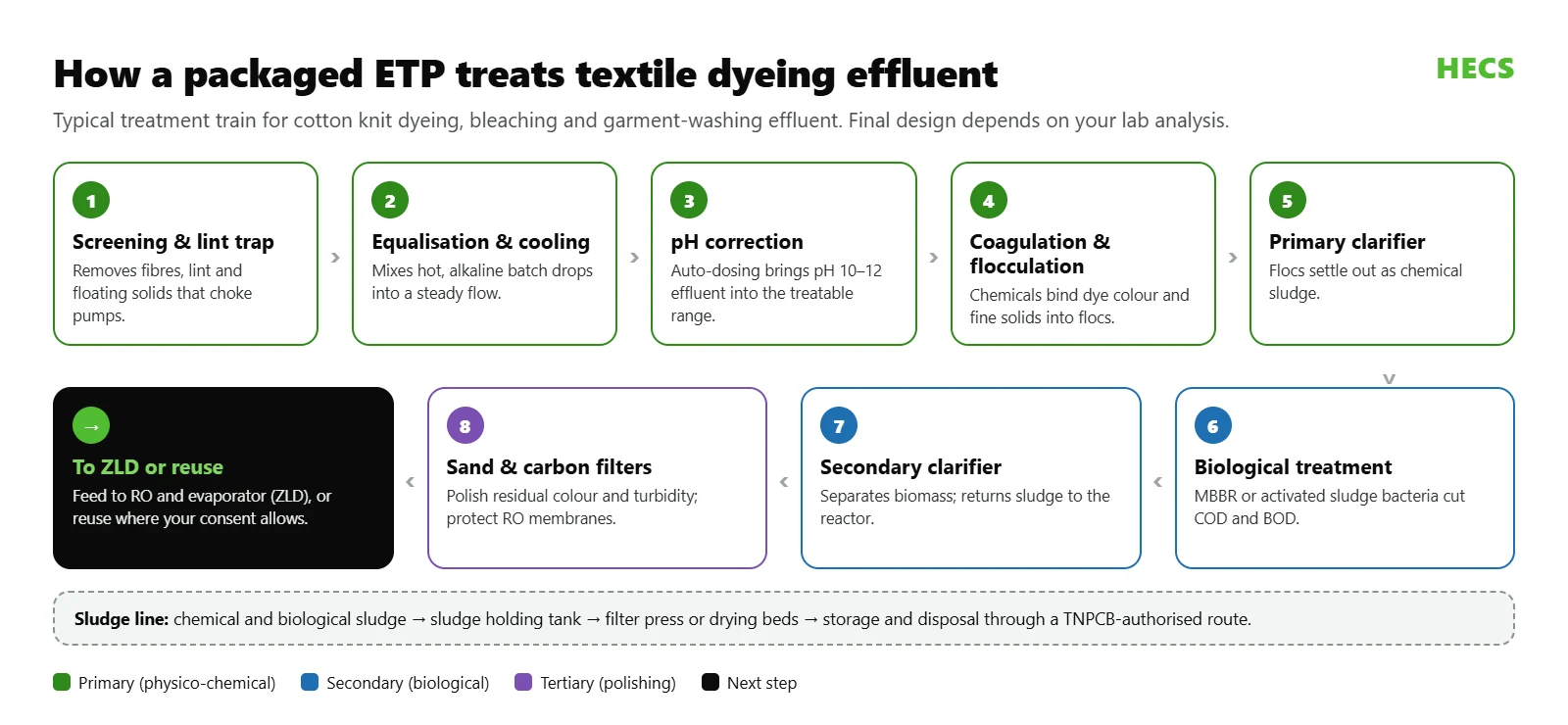
Which biological technology? MBBR (moving bed biofilm reactor) is compact and copes well with the shock loads of batch dyeing. Activated sludge suits larger, steadier flows. MBR (membrane bioreactor) gives the cleanest feed for RO in the smallest footprint, at a higher cost. HECS chooses after reviewing your lab analysis, flow pattern and ZLD plan.
From ETP to Zero Liquid Discharge: what each stage does
Short answer: the ETP removes colour, COD and solids; RO then recovers most of the water, an evaporator handles the salty reject, and a dryer turns what is left into solids.
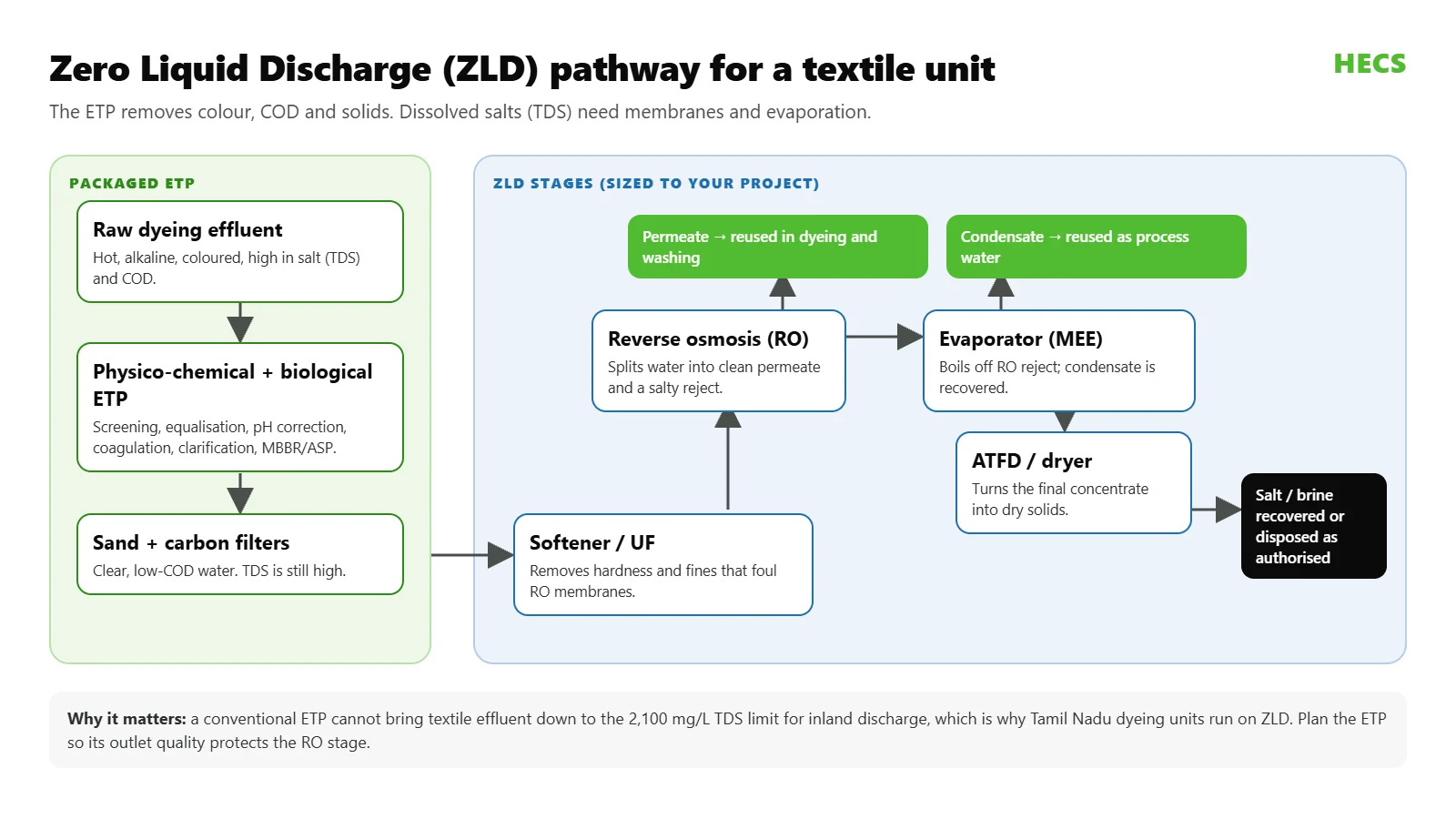
| Stage | What it does | What comes out |
|---|---|---|
| Softener / ultrafiltration | Removes hardness and fine solids | RO feed that will not scale or foul membranes |
| Reverse osmosis (RO) | Pushes water through membranes | Permeate (clean water) + salty reject |
| Multiple-effect evaporator (MEE) | Boils off the RO reject with steam | Condensate for reuse + thick brine |
| ATFD or dryer | Dries the final concentrate | Dry salt and solids |
| Salt and brine recovery | Separates salt for reuse where feasible | Brine reused in dyeing, or solids sent for authorised disposal |
Tip: ask for the ETP outlet quality (turbidity, TSS, COD, hardness, residual colour) to be written into the specification as RO feed-water limits. A cheap ETP that passes on colour and solids costs far more in membrane cleaning and replacement.
HECS designs the packaged ETP so its outlet suits your RO and evaporator, and plans the interfaces with your ZLD system, whether that is a new installation or an existing one.
What size ETP does a textile unit need?
Size the ETP from production, then check it against your water meter readings:
Example: a unit dyeing 200 kg of cotton knit fabric a day at about 275 litres per kg produces 200 × 275 ÷ 1,000 = 55 KLD of effluent. Add a margin for peaks and planned growth, so a 60–65 KLD plant is a sensible starting point. Low-liquor-ratio machines, water reuse and the mix of bleaching and dyeing change the figure, so send us your real numbers.
| Type of unit | Typical production | Indicative effluent |
|---|---|---|
| Garment washing, printing or sampling unit | Small, separate streams | 5–25 KLD |
| Small job-work dyeing unit | Up to about 100 kg/day | Up to about 30 KLD |
| Mid-size dyeing unit | 100–400 kg/day | About 25–120 KLD |
| Large or integrated processing unit | 400–2,000 kg/day | About 100–600 KLD |
| Textile park or common facility | Many units | 1 MLD and above (custom design) |
Indicative only, using 250–300 litres of water per kg of fabric. 1 KLD = 1,000 litres a day; 1 MLD = 1,000 KLD.
Not sure of your flow? Send us a week of water meter readings and your production plan, and our engineers will size the plant for you. Send your details
Packaged ETP vs conventional civil ETP
Short answer: a packaged ETP moves most of the work into a factory, so it is quicker to commission, needs less land and can grow module by module.
| Packaged ETP | Conventional civil ETP | |
|---|---|---|
| Where it is built | In a factory, then tested | Cast in concrete on site |
| Time to commission | Shorter: modules arrive ready to connect | Longer: months of civil work and curing |
| Footprint | Compact, above ground | Larger tanks and open area |
| Material | FRP that resists alkalis, acids and salt | RCC that needs protective lining |
| Expansion | Add modules as production grows | Extra civil construction |
| Relocation | Can be moved to a new site | Fixed |
| Best for | Up to mid-size flows, fast projects, limited land | Very large, steady flows |
How much does an ETP plant cost for a textile unit?
Short answer: there is no fixed price list. Capacity, effluent strength and how much of the ZLD system is included decide the capital cost; chemicals, power and evaporator steam decide the running cost.
What drives the capital cost
- Capacity and peak flowDaily KLD and how much arrives in batch drops.
- Effluent strengthCOD, colour and TDS from your lab report.
- ZLD scopeWhether RO, evaporator, dryer and salt recovery are included.
- TechnologyMBBR, activated sludge or MBR for the biological stage.
- Material and buildFRP modules, coated steel or civil tanks.
- AutomationDosing control, PLC, IoT and online monitoring.
- Sludge handlingFilter press, drying and storage area.
- Site workCollection sumps, piping, electricals and civil bases.
What drives the running cost
- ChemicalspH correction, coagulant, polymer and cleaning chemicals.
- PowerBlowers, pumps, mixers and RO high-pressure pumps.
- Steam or fuelUsually the biggest running cost of the evaporator.
- Sludge and salt disposalHazardous-waste storage, transport and disposal fees.
- People and testingOperators, lab tests and reporting.
- Membranes and mediaRO membrane cleaning and replacement, carbon refills.
Compare quotes on cost per KL treated over 10 years, not on purchase price alone. Energy is the largest operating cost of a ZLD plant, so blower and pump efficiency, RO recovery and evaporator steam use matter more than a small difference in capital cost.
TNPCB compliance checklist for a textile ETP
- Consent to Establish (CTE) from TNPCB under the Water Act, 1974 and Air Act, 1981, before you build or expand. Textile dyeing and bleaching is a Red category activity.
- A documented ZLD route: a CETP membership agreement, or an ETP + RO + evaporator design for your own plant.
- Consent to Operate (CTO) before production starts, and renewal before it expires.
- Metering and records: flow meters on water intake and effluent, energy meters and daily logbooks. Fit online monitoring if your consent asks for it.
- Hazardous waste authorisation for ETP sludge and evaporator salts under the Hazardous and Other Wastes Rules, 2016, with storage and disposal through an authorised facility.
- Regular testing of treated water by a recognised laboratory, with reports kept for inspection.
- Annual returns and inspections: keep consent copies, test reports, sludge manifests and logbooks ready.
Conditions change and vary by unit, so confirm the current requirements with your TNPCB district office or on the TNPCB website. HECS designs to the conditions written in your consent order and supports the technical documents for your application. For sewage norms, see our TNPCB guidelines for sewage treatment plants.
Design example: a 50 KLD packaged ETP for a knit dyeing unit
This is how HECS engineers would approach a typical mid-size dyeing unit. Your lab analysis, production plan and consent conditions decide the final design.
| Design item | Illustrative basis |
|---|---|
| Production | About 180 kg/day of cotton knit fabric (bleaching + reactive dyeing) |
| Design flow | 50 KLD (180 kg × about 275 L/kg), with equalisation for batch drops |
| Primary treatment | Screen and lint trap, cooling and equalisation, automatic pH correction, coagulation and flocculation, lamella clarifier |
| Biological treatment | MBBR in FRP modules, followed by a secondary clarifier |
| Tertiary treatment | Pressure sand filter + activated carbon filter |
| ZLD interface | Outlet quality set as RO feed limits; RO and evaporator sized to the measured TDS |
| Sludge | Filter press and covered storage for authorised disposal |
| Monitoring | pH and flow sensors with an IoT dashboard and daily reports |
HECS packaged ETP options for textile units
Hubert Enviro Care Systems (HECS) designs and manufactures packaged effluent treatment plants and builds them around your ZLD route. Two starting points:
HECS X-FLUENT compact ETP
A factory-assembled FRP packaged ETP with two-stage pH neutralisation and coagulation, integrated Clariflow clarification, bio-aeration, sand and carbon filters, chlorination with optional UV, and SmartHub IoT monitoring. Suits garment washing, printing, sampling and other small textile effluent streams.
See X-FLUENT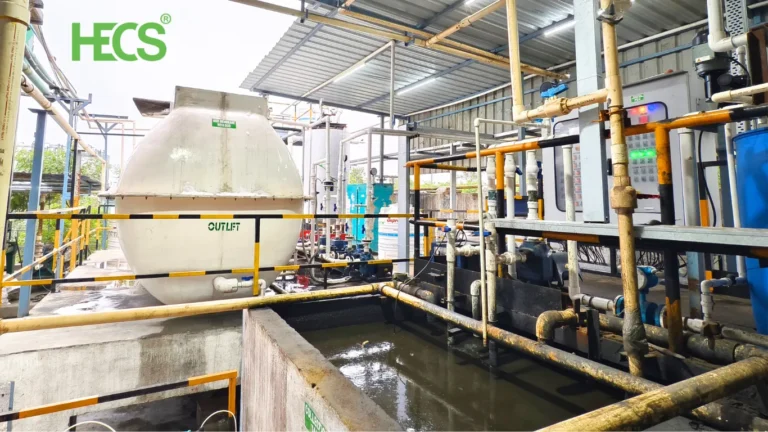
Customised packaged ETP
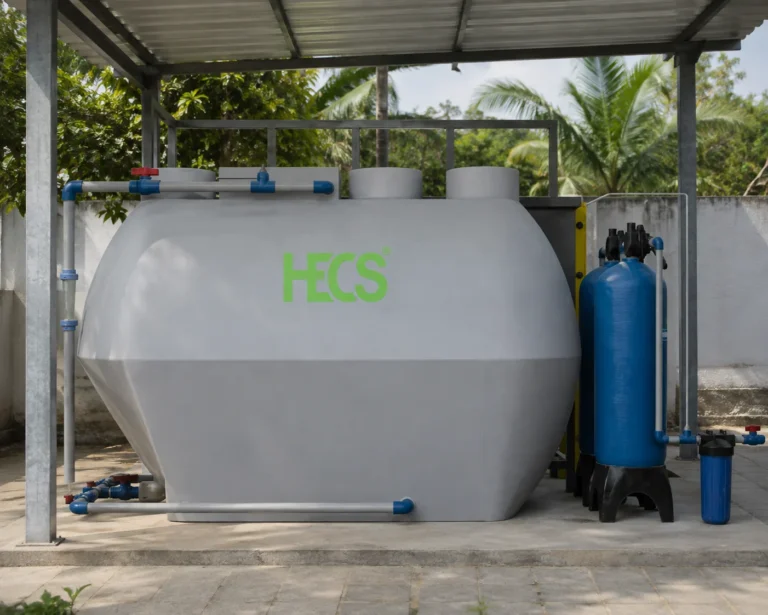
Engineered from your effluent analysis and production plan, with MBBR, MBR or activated sludge in corrosion-resistant FRP tanks, and an outlet quality matched to your RO and ZLD stages. Pictured: a 40 KLD packaged ETP installation.
See customised ETPsWhy textile units choose HECS
- 28+ years in wastewater: Hubert Enviro Care Systems has designed treatment plants since 1997
- Factory-built in Tamil Nadu: FRP modules made at our Sriperumbudur factory and tested before dispatch
- Large ETPs too: from 5 KLD compact units to a 1 MLD ETP for ONGC
- One team, start to finish: design, supply, installation, commissioning, O&M, AMC and lab testing
- IoT monitoring: SmartHub dashboards for pH, flow and equipment status
Does your garment or dyeing unit also need an STP?
Your ETP handles process effluent. Toilets, canteens and hostels for your workforce produce domestic sewage, which is a separate stream with its own discharge norms. Many garment and processing units treat it in a packaged STP and reuse the water for flushing and gardening.
HECS builds both, so one team can plan your ETP, STP and water reuse together. See industrial packaged STPs and the packaged sewage treatment plant buyer’s guide. For laundry effluent, see HECS ECO LAUNDER.
Textile ETP support across Tiruppur and western Tamil Nadu
- TiruppurKnitwear dyeing, bleaching, compacting and garment washing
- CoimbatoreSpinning, processing and engineering units
- Erode and BhavaniDyeing, printing and processing units
- KarurHome-textile dyeing and processing
- Salem and NamakkalTextile processing and allied industries
- Chennai and SriperumbudurOur base for design, fabrication and service
Frequently asked questions about textile ETPs
An ETP (effluent treatment plant) in the textile industry treats the wastewater from bleaching, dyeing, printing and washing. It corrects pH, removes colour and suspended solids with chemicals, reduces COD and BOD with bacteria, and polishes the water with sand and carbon filters so it can go on to RO and reuse.
In practice, yes. Since the Madras High Court orders of 2011, Tiruppur's bleaching and dyeing units have operated on ZLD, either through a CETP or through their own ETP with RO and evaporation. Your consent order from TNPCB states the exact conditions for your unit.
Yes. A unit can run its own ETP with ZLD (often called an IETP) if it gets TNPCB consent for it. It suits units that need capacity beyond their CETP allocation or want full control of water reuse, but it carries the full capital and running cost.
There is no fixed price. Cost depends on capacity and peak flow, effluent strength, how much of the ZLD system is included, the biological technology, materials, automation, sludge handling and site work. Running cost is driven by chemicals, power, evaporator steam and sludge disposal. HECS gives a sized quote after reviewing your production data and lab report.
Multiply the fabric you process each day (kg) by the litres of water used per kg, then divide by 1,000 to get KLD. For example, 200 kg a day at 275 litres per kg is about 55 KLD, so a 60–65 KLD plant allows for peaks.
No. An ETP removes colour, COD, BOD and suspended solids, but dissolved salts pass through. Reducing TDS needs reverse osmosis, and the salty RO reject needs an evaporator to reach Zero Liquid Discharge.
An ETP treats industrial process effluent, such as dyeing wastewater. An STP treats domestic sewage from toilets and kitchens. A CETP is a common effluent treatment plant shared by a group of industrial units, which send their effluent to it for treatment.
Less time than a civil ETP, because the modules are built and tested in a factory and only need foundations, piping and electrical connections on site. The schedule depends on capacity, site readiness and the ZLD stages, and HECS confirms it with the quote.
Chemical and biological sludge is thickened, dewatered in a filter press or drying beds, stored under cover and sent for disposal through an authorised facility under your hazardous waste authorisation. Evaporator salts are handled the same way unless they are recovered for reuse.
Yes, after RO. In Tiruppur's ZLD systems, RO permeate and evaporator condensate are reused as process water, and recovered brine is reused in dyeing. Water straight from the ETP is usually too salty for reactive dyeing.
Yes. Hubert Enviro Care Systems (HECS) designs, supplies, installs and maintains packaged ETPs and STPs across Tamil Nadu, including Tiruppur, Coimbatore, Erode and Karur. Share your production details through the enquiry form or WhatsApp.
Planning an ETP for your dyeing or washing unit?
Send us your production and water data. We will recommend a route (CETP, own ETP or packaged ETP), size the plant and explain the ZLD interfaces before you commit.
Get a textile ETP proposal
Fill in the form and include as much of this as you can:
- Process: bleaching, dyeing, printing or washing
- Fabric processed per day (kg) or daily water use
- Latest effluent lab report, if you have one
- Your ZLD route: CETP or own plant
- Space available and site location
Prefer to talk?
Sources
- CETPs: an untapped opportunity for energy efficiency, Citizen consumer and civic Action Group (CAG), 13 April 2026.
- Tirupur dyeing units told to close, Down To Earth, 14 February 2011.
- HC orders closure of Tirupur bleaching and dyeing units, Deccan Herald, 28 January 2011.
- Kuppandampalayam Effluent Treatment Pvt Ltd v. The Chairman, TNPCB, National Green Tribunal, 2014.
- Tamil Nadu Pollution Control Board and Central Pollution Control Board.