
Quick answer: treated water from a building STP can be reused for toilet flushing, landscaping and cooling towers, but not for drinking. Reuse needs a polishing step after biological treatment (filtration and disinfection, or a membrane plant such as MBR), a separate storage tank and separate pipes. For buildings of 20,000 sq m and more, MoEFCC’s 2016 building conditions require treated water to be reused on site.

Plus gardens and cooling towers
Keep pipes fully separate
BOD and TSS, HECS Amaze (MBR)
Reuse on site required (2016)
Where treated water can be used
| Use | Treatment after the biological stage | Points to check |
|---|---|---|
| Landscaping and gardens | Filtration and disinfection | Drip or sprinkler lines; avoid spraying near people |
| Toilet flushing | Filtration and disinfection, or MBR | Separate flushing line and tank; label pipes as non-potable |
| Cooling towers | Filtration and disinfection | Hardness and dissolved solids limits from the tower supplier |
| Floor and vehicle washing | Filtration and disinfection | Separate taps, clearly marked |
| Drinking, cooking, bathing | Not allowed | Keep fully separate from drinking water |
What the rules say
MoEFCC’s environmental conditions for building bye-laws (S.O. 3999(E), 9 December 2016) make reuse part of the building rules:
- 5,000 to 20,000 sq m: treated effluent should be reused as far as possible, with the excess discharged to CPCB norms.
- 20,000 sq m and more: treated water shall be reused on site for landscaping, flushing, cooling towers and other uses.
- 50,000 sq m and more: dual plumbing, separating grey and black water or giving flushing its own recirculation line.
Your pollution control board consent sets the treated-water limits. See is an STP mandatory? for the full table.
The treatment train for reuse
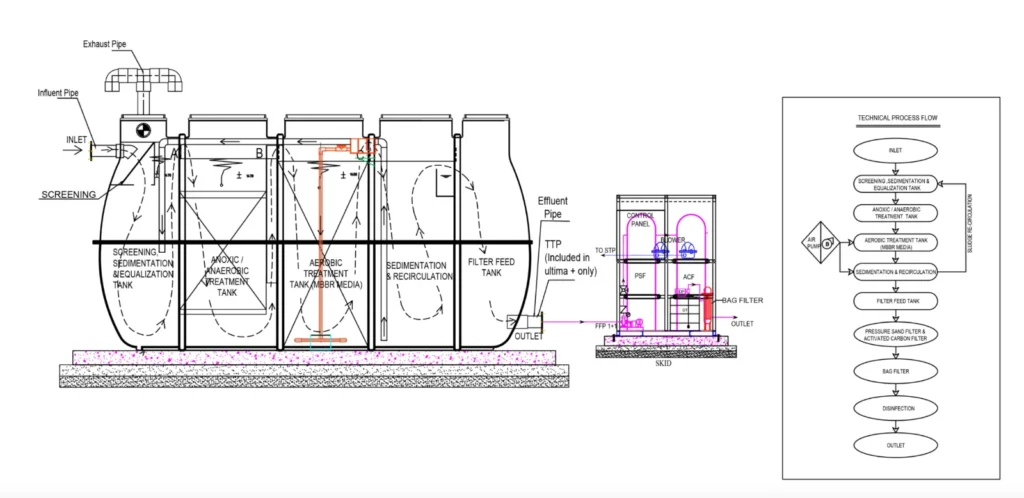
- Biological treatment: MBBR (HECS Ultima) or MBR (HECS Amaze) removes most of the BOD and solids.
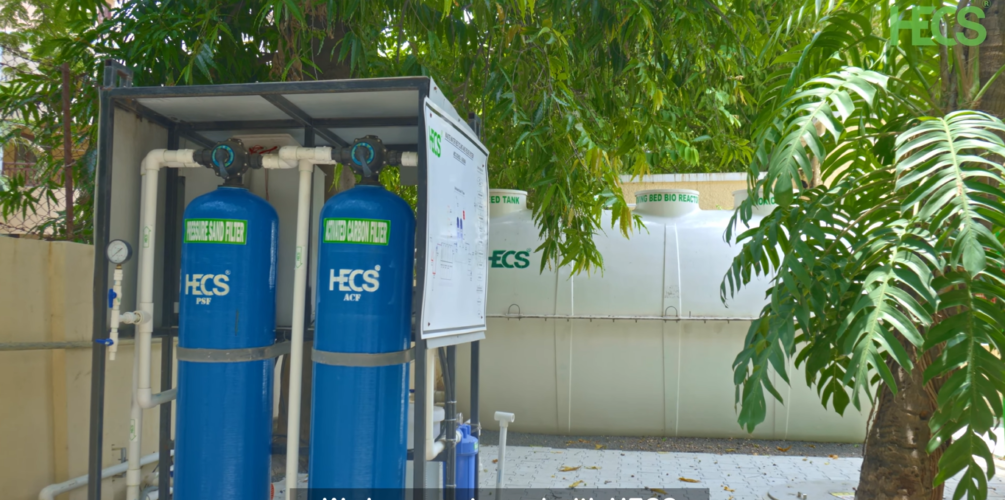
- Filtration: pressure sand and activated carbon filters, or ultrafiltration, remove fine solids. MBR membranes do this inside the plant.
- Disinfection: chlorination or UV before storage.
- Treated-water tank: covered, separate, with its own pumps.
- Distribution: separate pipes to flushing, garden and cooling points.
HECS Amaze is designed for BOD and TSS below 5 mg/l in a smaller footprint, which suits buildings that reuse most of their water.
How much water reuse can save
A 100-flat building with 500 residents at 135 litres per person makes about 54 KLD of sewage (500 × 135 × 0.8). Planning figures commonly allow about 45 litres per person a day for flushing, which is about 22.5 KLD. Treated water can cover all of it, with the rest available for gardens. Work out your own numbers with the capacity calculator.

HECS reuse examples
- Porvorim, Goa (100 KLD, SIDCGL): treated water is piped 120 m and 180 m to irrigate Forest Park and Science Park. Case study.
- Lords 83, Wayanad (50 KLD): ultrafiltered water is reused for gardening, pathways and toilet flushing. Case study.
- MCC School, Chennai (10 KLD): treated water is reused for gardening. Case study.
- Global Pharma (6 KLD STP): STP water is used for irrigation, cooling towers and other utilities. Case study.
Treated water reuse: FAQs
Can’t find your answer? Ask an HECS engineer. We reply within minutes.
Is treated STP water safe to use?
For non-potable uses such as flushing, landscaping and cooling, yes, when the plant meets its consent limits and the water is filtered and disinfected after biological treatment. It must not be used for drinking, cooking or bathing.
Can STP water be used for drinking?
No. Building STPs are designed for discharge or non-potable reuse. Keep treated-water pipes and tanks fully separate from the drinking-water supply.
Do I need dual plumbing?
Flushing with treated water needs a separate flushing line. Under MoEFCC’s 2016 building conditions, buildings of 50,000 sq m and more must provide dual plumbing.
What treatment is needed for flushing water?
After the biological stage, filtration (for example pressure sand and activated carbon filters, or ultrafiltration) and disinfection. An MBR plant such as HECS Amaze is designed for BOD and TSS below 5 mg/l, which suits reuse.
Can treated water be used in cooling towers?
Yes, it is one of the uses named in the 2016 building conditions. Check the cooling tower supplier’s limits for hardness and dissolved solids, which a biological STP does not remove.
How should treated water be stored?
In a separate, covered treated-water tank with its own pumps and pipes, labelled as non-potable, with no connection to the drinking-water system.
Plan reuse with your STP
Tell us your building type, users or KLD and where you want to reuse water. We reply within minutes.