
Quick answer: a packaged STP gives a construction site or labour camp proper sewage treatment instead of overflowing septic tanks or tankers. Factory-built FRP units sit above ground, install in days, can be reused for dust suppression and flushing, and can be moved to the next project when the site closes. Size the plant on the peak number of workers living on site.

To install a HECS Ultima unit
Little excavation
Add units as the workforce peaks
Dust suppression and flushing
Why sites need sewage treatment
- Labour camps are small townships: hundreds of workers living on site produce sewage every day for the life of the project.
- Septic tanks and tankers fall short: they overflow in the monsoon, smell and cost money every week.
- Conditions and inspections: environmental clearance, consent and local body conditions often cover worker sanitation. Check yours early.
- Water: treated water can cut fresh-water use for dust suppression and wheel washing.
Why a packaged FRP unit fits a site
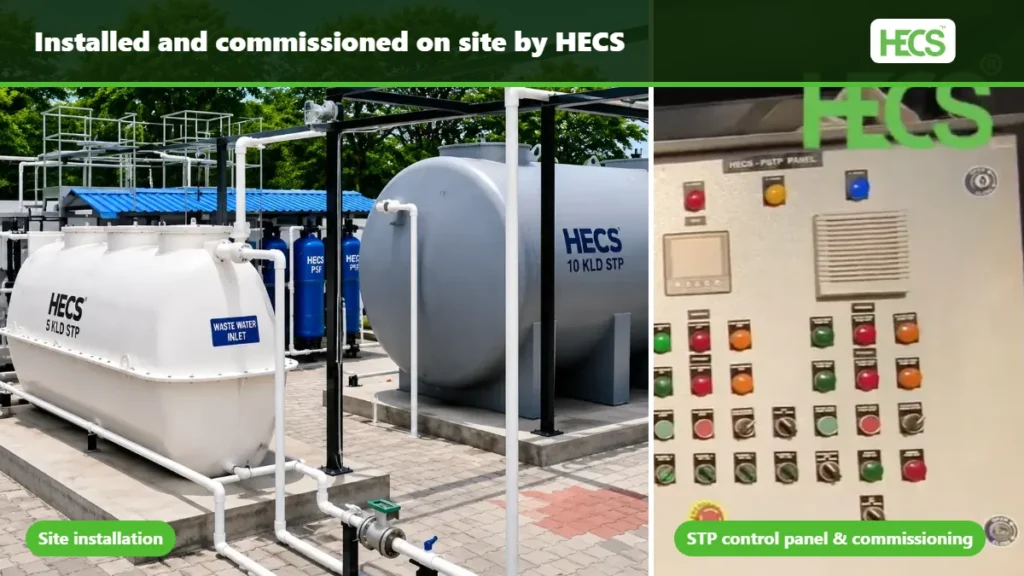
- Above ground: little excavation; the unit sits on a level base near the camp.
- Fast: a HECS Ultima unit installs in about two days once the base is ready.
- Relocatable: when the project ends, the unit can be emptied, cleaned and moved to the next site by your team. HECS does not offer rental or buy-back.
- Modular: add a module when the workforce peaks.
- Low attention: HECS Ultima typically needs 1–2 hours a week at small and mid capacities, and HECS SmartHub sends alerts to the site team.
Read FRP vs RCC STP for how factory-built plants compare with concrete ones.

How to size a site STP
Daily sewage (KLD) = workers × water supplied per worker per day × 0.8 ÷ 1,000. Use the water you actually supply in the camp, and size on the peak workforce, not the average.
| Workforce | Water per worker (assumed) | Sewage | Suggested plant |
|---|---|---|---|
| 150 resident workers | 100 litres | 12 KLD | 15 KLD |
| 300 resident workers | 100 litres | 24 KLD | 25 KLD |
| 600 resident workers | 100 litres | 48 KLD | 50 KLD, or 2 × 25 KLD modules |
The 100 litres per worker is an assumption for the example; replace it with your camp’s figure. Use the capacity calculator and STP capacity calculation.
Planning checklist
- Peak number of workers living on site, and day workers
- Water supply per worker and the source
- Space for the unit, the base and tanker access for sludge
- Power: grid or DG, with the STP load included
- Where treated water will go: dust suppression, wheel wash, flushing or discharge
- Who runs the plant day to day, and remote alerts
- What happens at the end of the project: move, keep or hand over
From the site to the finished building
A site STP serves the workforce during construction. The finished building usually needs its own permanent STP, sized on its future occupants and built into the design from the start. See packaged STP guide and is an STP mandatory?.
STP for construction sites: FAQs
Can’t find your answer? Ask an HECS engineer. We reply within minutes.
Does a construction site need an STP?
Workers on site generate sewage every day, and a site with a labour camp generates as much as a small housing colony. Check your environmental clearance, consent and local body conditions for what is required on your project.
Can a packaged STP be moved to the next site?
Yes. FRP packaged units are self-contained, so they can be emptied, cleaned, lifted and placed on a new base at the next site. HECS does not offer rental or buy-back, so plan the move with your own team.
How big should a site STP be?
Size it on the peak number of workers living on site and the water they are supplied. For example, 300 resident workers at 100 litres a day make about 300 × 100 × 0.8 = 24 KLD of sewage. Add day workers at a lower figure.
Can treated water be reused on a construction site?
Yes, for dust suppression, wheel washing and toilet flushing, after filtration and disinfection. Check with your engineer before using it for concrete curing or mixing.
What about power on site?
Blowers run for most of the day, so plan a steady supply. If the site runs on a DG set, include the STP load in the DG sizing.
How fast can it be installed?
A HECS Ultima unit is installed in about two days once the base is ready, because it arrives factory-built.
Need an STP for your site or labour camp?
Share the peak workforce, location, power source and how long the project will run. We reply within minutes.