
Quick answer: an FRP (fibre-reinforced plastic) packaged STP is built and tested in a factory and installed in days, resists corrosion, and can be relocated or extended with modules. An RCC (reinforced concrete) STP is built on site over months and suits very large or municipal plants where civil works are planned anyway. For most buildings from a few KLD to a few hundred KLD, FRP is faster and simpler; for very large capacities, compare both.

To install a HECS Ultima unit
Typical RCC civil build
Ground install options for FRP
HECS FRP technologies
What is an FRP STP and an RCC STP?
FRP STP: the treatment tanks are moulded from glass-fibre-reinforced plastic in a factory, fitted with blowers, pumps and controls, tested and delivered as one or more units. RCC STP: the tanks are cast in reinforced concrete on site, then waterproofed, fitted out and commissioned.
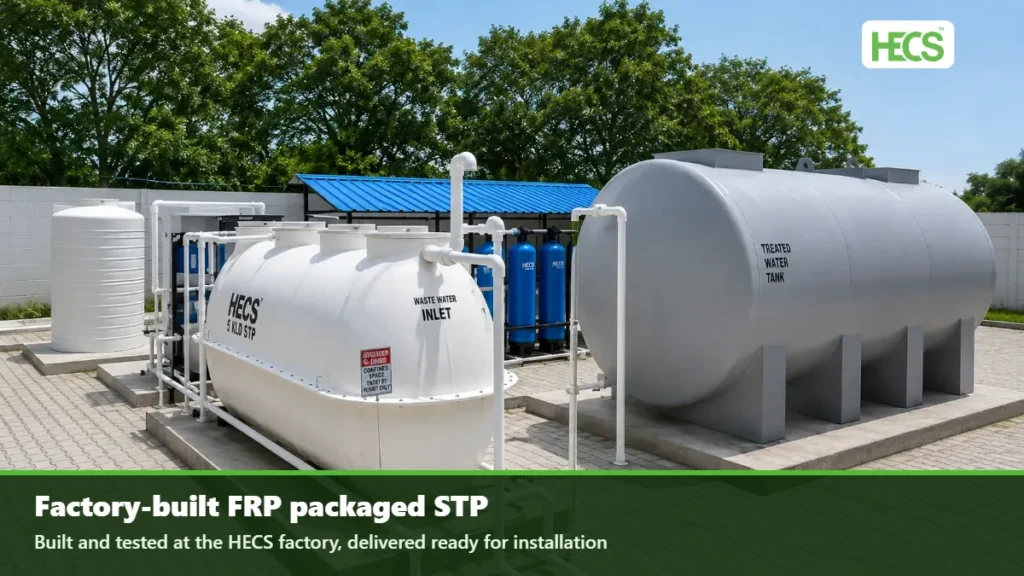
FRP vs RCC at a glance
| Factor | FRP packaged STP | RCC (civil) STP |
|---|---|---|
| Build time | Factory-built; a HECS Ultima unit installs in about two days | Months of civil work on site |
| Corrosion | Does not rust; resists hydrogen sulphide and sewage chemicals | Concrete can be attacked by hydrogen sulphide unless lined or coated |
| Leaks | Leak-tested before dispatch | Depends on site workmanship; needs waterproofing |
| Space | Compact; above or below ground | Needs more area and excavation |
| Relocation and expansion | Can be moved, or extended with extra modules | Fixed; expansion means new civil work |
| Capacity range | Small to medium-large (HECS: about 1–1,000 KLD) | Any size, including municipal scale |
| Site disruption | Low: a base or pit, then placement | High: excavation, formwork, curing |
| Things to watch | Anchoring against buoyancy when buried in high groundwater; UV protection if exposed; laminate quality | Construction quality, curing, waterproofing and corrosion protection |
When RCC still makes sense
- Very large or municipal plants, beyond the practical size of factory-built units
- Projects where the plant is designed into a basement or podium structure from the start
- Extensions of an existing concrete plant that must match it
Questions to ask an FRP STP supplier
- What resin and laminate thickness do you use, and what design life and warranty do you give?
- Is each unit leak-tested before dispatch?
- How is the tank anchored if it is buried and groundwater is high?
- What does the price include: base or pit, installation, commissioning, IoT monitoring?
- Can modules be added later, and how is the layout planned for that?
- Which projects of a similar size can I see or speak to?

HECS FRP packaged STPs
HECS builds FRP packaged STPs with MBBR (HECS Ultima) and MBR (HECS Amaze) technology. Units are tested before dispatch, installed above or below ground, and monitored through HECS SmartHub. See our packaged sewage treatment plant guide and packaged STP guide.
FRP vs RCC STP: FAQs
Can’t find your answer? Ask an HECS engineer. We reply within minutes.
Is FRP better than RCC for an STP?
For most buildings, yes: FRP plants are factory-built, corrosion-resistant and installed in days. RCC suits very large or municipal plants and projects where the civil structure is planned anyway.
How long does an FRP STP last?
It depends on the laminate quality, installation and maintenance. Ask the supplier for the design life and warranty in writing.
Can an FRP STP be installed underground?
Yes. Buried units need a proper pit and anchoring where groundwater is high, so an empty tank cannot float.
Is an FRP STP cheaper than RCC?
Often, for small and mid-size plants, because there is less civil work and a shorter build. Compare full quotes that include civil work, installation and O&M.
Does an FRP STP smell?
A well-run plant of either type should not smell. Odour usually comes from poor aeration or sludge build-up, which regular maintenance prevents.
Can an FRP STP be relocated?
Yes. Factory-built units can be moved to a new site, which helps temporary or phased projects.
Compare an FRP packaged STP for your site
Share your users or KLD, available space and whether you prefer above or below ground, and we will send a layout and quote.
[…] FRP vs RCC STP for how factory-built plants compare with concrete […]