
Quick answer: in India, a building of 20,000 sq m or more built-up area must treat 100% of its sewage on site and reuse the treated water, under the environmental conditions for building bye-laws that MoEFCC notified on 9 December 2016. Buildings of 5,000 to 20,000 sq m must install on-site treatment where there is no municipal sewer. States, local bodies and pollution control boards can set stricter rules, so check your building approval and consent conditions.
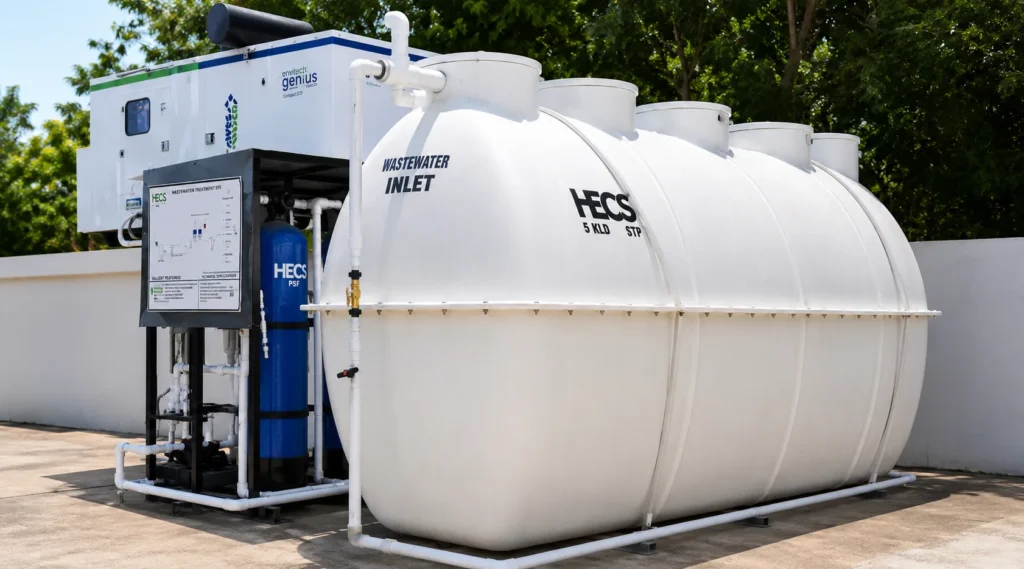
On-site treatment if no sewer
STP for 100% of wastewater
Dual plumbing as well
MoEFCC notification S.O. 3999(E)
The national rule: built-up area decides
| Built-up area | Sewage treatment | Reuse of treated water | Plumbing |
|---|---|---|---|
| 5,000 to under 20,000 sq m | On-site treatment where there is no municipal sewer | Reuse as far as possible; excess discharged to CPCB norms | No specific condition |
| 20,000 to under 50,000 sq m | On-site STP that treats 100% of the wastewater | Reuse on site for landscaping, flushing, cooling towers and other uses | No specific condition |
| 50,000 to 1,50,000 sq m | On-site STP that treats 100% of the wastewater | Reuse on site for landscaping, flushing, cooling towers and other uses | Dual plumbing: grey and black water separated, or separate flushing lines |
Source: MoEFCC notification S.O. 3999(E), 9 December 2016, on integrating environmental conditions into building bye-laws. For every category, sludge from on-site treatment, including septic tanks, must be collected, conveyed and disposed of as per the CPHEEO Manual on Sewerage and Sewage Treatment Systems, 2013.
Environmental clearance for larger projects
Building and construction projects of more than 20,000 sq m and less than 1,50,000 sq m built-up area are listed under item 8(a) of the EIA Notification, 2006. Larger townships and area development projects fall under item 8(b). These projects go through environmental appraisal, and the conditions cover water use and sewage treatment. Ask your environmental consultant which route applies in your state.
State and local rules can be stricter
States and local bodies write these conditions into their own building rules and can set thresholds by number of flats, sewage volume or type of building. Karnataka, for example, has revised its apartment STP rule more than once since 2016, so always check the current order. The State Pollution Control Board consent then sets the outlet limits your plant must meet.
HECS guides by state: Tamil Nadu · Karnataka · Kerala · Goa · Maharashtra · Andhra Pradesh · Telangana · all of India.
Outlet standards your STP must meet
The outlet limits come from your consent, which follows the national STP standards and any stricter state or tribunal orders. Read CPCB regulations for STPs, NGT outlet norms and STP discharge standards. If treated water is reused for flushing or cooling, plan filtration and disinfection after the biological stage, or an MBR plant such as HECS Amaze.
What to check before you build
- Built-up area and sewer: which 2016 category the project falls in, and whether a municipal sewer is available.
- Local building rules: any state or city threshold by flats, KLD or building type.
- Consent: whether the project needs CTE and CTO, and the outlet limits.
- Reuse plan: flushing, landscaping or cooling, and dual plumbing for large buildings.
- Space and access: above or below ground, sludge removal and maintenance access.
- Running the plant: who operates it, and how faults are caught.
Then size the plant with our STP capacity calculation guide.
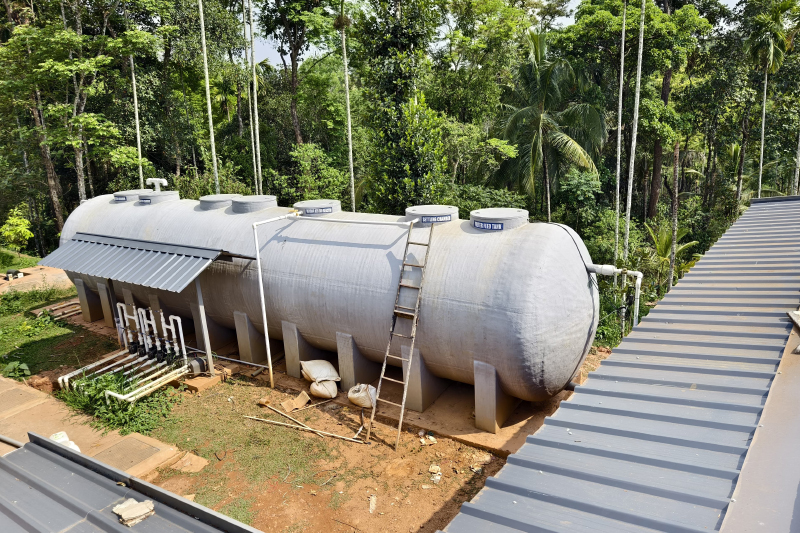
Is an STP mandatory: FAQs
Can’t find your answer? Ask an HECS engineer. We reply within minutes.
Is an STP mandatory for apartments?
For large apartment projects, yes. Under MoEFCC’s December 2016 building conditions, buildings of 20,000 sq m or more must have an on-site STP for 100% of their wastewater and reuse the treated water. Smaller buildings of 5,000 to 20,000 sq m need on-site treatment where there is no municipal sewer. States and local bodies can set stricter rules by number of flats or sewage volume.
Is an STP needed if the building connects to a municipal sewer?
In the 2016 conditions, the sewer exception appears only for buildings of 5,000 to 20,000 sq m. For 20,000 sq m and more, the conditions call for on-site treatment of 100% of the wastewater. Your local building rules and consent decide the final position.
Is a septic tank enough?
For larger buildings, no: the 2016 conditions call for on-site treatment and reuse. Where septic tanks are used, sludge must be collected, conveyed and disposed of as per the CPHEEO Manual on Sewerage and Sewage Treatment Systems, 2013.
Who gives the approval for an STP?
The State Pollution Control Board gives the Consent to Establish before construction and the Consent to Operate before the plant runs, and sets the outlet limits. Larger projects may also need environmental clearance, and the local body checks the building approval.
Does treated water have to be reused?
For buildings of 20,000 sq m and more, the 2016 conditions require treated water to be reused on site for landscaping, flushing and cooling towers, with excess discharged to CPCB norms. Buildings of 50,000 sq m and more also need dual plumbing.
What if the STP is not working?
The board can refuse or withhold renewal of the consent and act under the Water Act, and residents lose the water savings. Plan operation and maintenance from day one, with remote monitoring if possible.
Find out what your building needs
Share the built-up area, building type, users or flats and city. An HECS engineer will suggest the right plant.
[…] Read our TNPCB STP guidelines and is an STP mandatory?. […]