
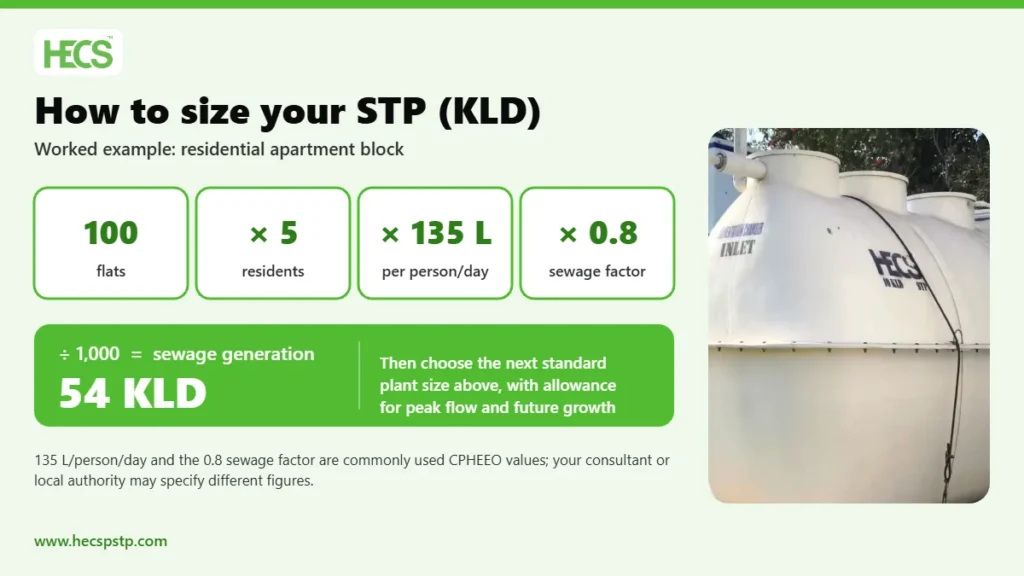
Quick answer: STP capacity (KLD) = number of users × water use per person per day (litres) × 0.8 ÷ 1,000. The 0.8 is the share of water that returns as sewage. Example: 500 residents × 135 litres × 0.8 = 54,000 litres a day, or 54 KLD. Then allow for peak flow and future phases before choosing the plant size.
Common packaged STP sizes, with who each one suits: 10 KLD, 50 KLD and 100 KLD.
Water per resident a day (NBC 2016)
Share of water that returns as sewage
CPHEEO peak factors
BOD of typical domestic sewage
Step 1: Count the users
Use the design population, not today’s occupancy: residents per flat (commonly 5 for planning), beds in hotels and hospitals, staff and visitors in offices, and students and staff in schools. Count each user group separately.
Step 2: Find the water use per person
| Building type | Water use (NBC 2016, Part 9) |
|---|---|
| Residences | 135 litres per person per day |
| Hotels with lodging | 180 litres per bed per day (more for luxury hotels) |
| Hospitals up to 100 beds | 340 litres per bed per day |
| Hospitals over 100 beds | 450 litres per bed per day |
| Hostels and boarding schools | 135 litres per person per day |
| Offices | 45 litres per person per day |
| Day schools | 45 litres per person per day |
| Restaurants | 70 litres per seat per day |
| Factories with bathrooms | 45 litres per person per day |
Use your own metered or design water figures if you have them, and follow any figure your local authority or consultant specifies.
Step 3: Convert water to sewage
About 80% of the water supplied ends up as sewage, the design basis in the CPHEEO manual; the rest is used for gardening and cooking or evaporates. Multiply daily water use by 0.8. If garden or cooling water comes from a separate supply, leave it out.
Step 4: Allow for peak flow
Sewage does not arrive evenly: mornings and evenings bring peaks well above the average hourly flow. CPHEEO peak factors range from 2.0 for large populations to 3.0 for populations up to 20,000, so building-level plants sit at the higher end. A packaged STP handles this with an equalisation (collection) tank sized for the peaks, so the treatment stages see an even flow. Add a sensible margin and plan future phases as extra modules rather than oversizing on day one.
Step 5: Check the organic load
Capacity is not only volume. The biological stage is sized on the organic load: BOD load (kg a day) = flow (KLD) × BOD (mg/l) ÷ 1,000. Typical domestic sewage carries about 300 mg/l of BOD, so a 54 KLD flow brings about 16 kg of BOD a day. Kitchens, laundries and hospitals raise this, so share any effluent data you have with the designer.
Worked examples
| Project | Calculation | Sewage | Suggested plant |
|---|---|---|---|
| Apartments, 100 flats | 100 × 5 × 135 × 0.8 | 54 KLD | 60 KLD |
| Hotel, 120 beds and 50 staff | (120 × 180 + 50 × 45) × 0.8 | about 19 KLD | 20–25 KLD |
| Hospital, 200 beds | 200 × 450 × 0.8 | 72 KLD | 75–80 KLD, plus an ETP for lab and laundry effluent |
| Office or IT park, 2,000 staff | 2,000 × 45 × 0.8 | 72 KLD | 75–80 KLD |
| Day school, 1,500 students and staff | 1,500 × 45 × 0.8 | 54 KLD | 60 KLD |
Common sizing mistakes
- Sizing on today’s occupancy instead of the design population
- Forgetting staff, visitors, kitchens or laundries
- Ignoring peak flow, which overloads small plants in the morning
- Oversizing on day one, which leaves the biology under-loaded; plan modules for later phases
- Treating hospital lab and laundry effluent as sewage instead of sending it to an ETP

Get a first estimate in a minute
Use the HECS water consumption and sewage generation calculator for a first estimate, then see our packaged STP guide and STP cost guide. An HECS engineer confirms the final size from your site data.
STP capacity calculation: FAQs
Can’t find your answer? Ask an HECS engineer. We reply within minutes.
How do you calculate STP capacity?
Multiply the number of users by water use per person per day and by 0.8, then divide by 1,000 to get KLD. Allow for peak flow and future phases before choosing the size.
What is the formula for STP capacity in KLD?
KLD = users × litres per person per day × 0.8 ÷ 1,000.
How much sewage does one person produce per day?
At 135 litres of water per person a day and 80% return, about 108 litres of sewage a day.
What size STP is needed for 100 flats?
About 54 KLD at 5 residents per flat, so a 60 KLD plant is a sensible start.
How do you calculate STP capacity for a hospital?
Use beds × water per bed (340 litres up to 100 beds, 450 litres above 100 beds under NBC 2016) × 0.8, and send lab, OT and laundry effluent to an ETP.
What does 100 KLD capacity mean?
The plant treats 100,000 litres of sewage a day, enough for roughly 900 residents at 135 litres per person.
Get your STP sized by an engineer
Send your building type, users or flats and city. We will confirm the capacity and quote the right packaged STP.
[…] Then size the plant with our STP capacity calculation guide. […]
[…] The 100 litres per worker is an assumption for the example; replace it with your camp’s figure. Use the capacity calculator and STP capacity calculation. […]
[…] Example: 100 flats × 5 residents × 135 litres × 0.8 = 54 KLD, so a 60 KLD plant is a sensible start. Use the capacity calculator, the packaged STP guide and STP capacity calculation. […]